Orchard plan · Free PDF
Warm-Climate Orchard Plan
Six trees for zones 8 to 10: two dwarf citrus, a fig, two pomegranates and an Asian persimmon, drawn to scale with picks for each zone.
40 × 45 feet, 6 trees, every spacing from university extension figures. Print the plan, mark out the trees, then fill each spot from the picks for your zone.
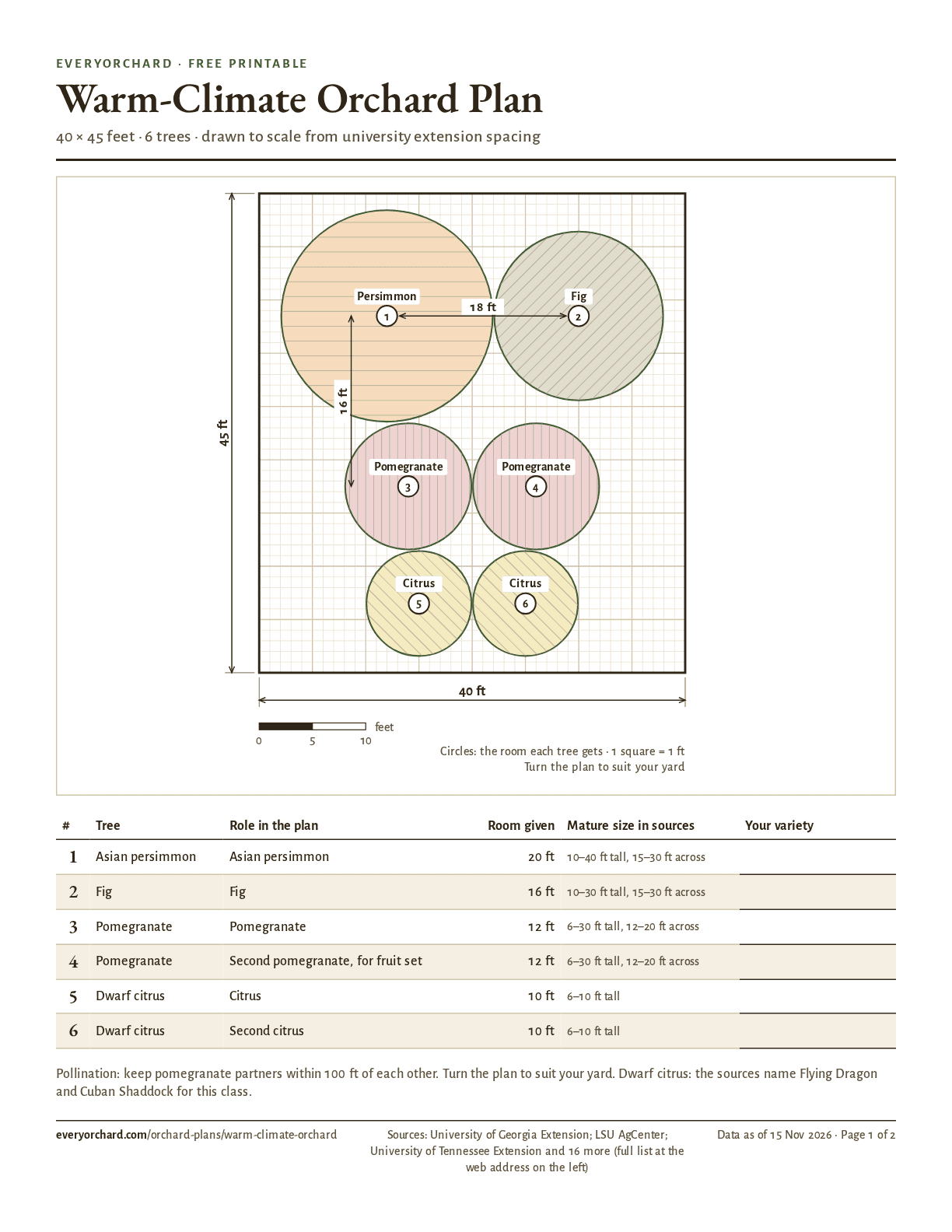
The plan, to scale
Each circle is the room that tree gets, from the spacing extension sources recommend for its size; each square is one foot. Turn the plan to suit your yard.
Why this plan works
This plan is for zones 8 to 10, where winters are mild: six trees of fruits that suit warm gardens, an Asian persimmon, a fig, two pomegranates and two dwarf citrus. Oriental persimmons don't need cross-pollination to set fruit, and most citrus cultivars are self-compatible, so a single tree fruits. The pomegranates are a pair: Clemson advises two or more because cross-pollination increases fruit set, though Arizona and Georgia call them self-fruitful.
The persimmon gets the largest circle, 20 feet, and the dwarf citrus the smallest, 10 feet. With the zone 9 picks below, the harvest runs from August (Black Mission) to December (Owari Satsuma).
Figs want full sun, at least 8 hours a day by Clemson's count. The one thing to get right is cold: where freezes are likely, grow only the hardiest citrus, such as kumquats and satsuma mandarins, since lemons and limes are among the least cold-hardy.
What you need
- Space: 40 by 45 feet, about 1800 square feet.
- Trees: 1 asian persimmon, 1 fig, 2 pomegranates, 2 dwarf citrus.
- Sun: At least 6 hours of direct sun a day; some sources ask for 8.
- Pomegranate partners: keep them within 100 feet of each other. Each pair here stands closer than that.
Plant list
| # | Tree | Role | Room given | Mature size in sources |
|---|---|---|---|---|
| 1 | Asian persimmon | Asian persimmon | 20 ft | 10–40 ft tall, 15–30 ft across |
| 2 | Fig | Fig | 16 ft | 10–30 ft tall, 15–30 ft across |
| 3 | Pomegranate | Pomegranate | 12 ft | 6–29.5 ft tall, 12–20 ft across |
| 4 | Pomegranate | Second pomegranate, for fruit set | 12 ft | 6–29.5 ft tall, 12–20 ft across |
| 5 | Dwarf citrus | Citrus | 10 ft | 6–10 ft tall |
| 6 | Dwarf citrus | Second citrus | 10 ft | 6–10 ft tall |
- Dwarf citrus: the sources name Flying Dragon and Cuban Shaddock for this class.
Variety picks for your zone
Every pick is a good fit for the zone by the site’s fit check (chill hours and cold hardiness at a typical location in that zone), and every tree that needs a partner has one in the plan whose bloom overlaps. Where the site’s data has no variety for a spot, the panel says so. Check your own ZIP with the variety fit tool.
Picks for zone 8
- 1
- 2
Fig
Good fit for zone 8; self-fruitful; harvest Aug–Nov.
- 3
Pomegranate
Good fit for zone 8; a second variety for fruit set: Angel Red (tree 4); harvest Sep–Oct.
Or: Salavatski
- 4
Second pomegranate, for fruit set
Good fit for zone 8; a second variety for fruit set: Parfianka (tree 3); harvest Aug–Oct.
Or: Salavatski
- 5
Citrus
Zone 8 gets freezes, and Texas A&M says to grow only the hardiest citrus there, such as kumquats, satsuma mandarins, tangerines and calamondin; LSU counts lemons and limes among the least cold-hardy. None of the hardy types in the site's data is rated for zone 8 by extension sources, so no variety is picked.
- 6
Second citrus
Zone 8 gets freezes, and Texas A&M says to grow only the hardiest citrus there, such as kumquats, satsuma mandarins, tangerines and calamondin; LSU counts lemons and limes among the least cold-hardy. None of the hardy types in the site's data is rated for zone 8 by extension sources, so no variety is picked.
Picks for zone 9
- 1
- 2
- 3
- 4
- 5
Citrus
Good fit for zone 9; self-fruitful; harvest Oct–Dec. Rated by type: extension sources say satsumas survive about 15°F (the middle of their figures), and zone 8b is the coldest zone whose coldest nights stay above that. Zone 9 gets freezes, and extension sources rate satsumas hardy there only with freeze protection in cold snaps, so cover or protect Owari Satsuma on freezing nights.
- 6
Second citrus
Good fit for zone 9; self-fruitful; harvest Oct–Dec. Rated by type: extension sources say satsumas survive about 15°F (the middle of their figures), and zone 8b is the coldest zone whose coldest nights stay above that. Zone 9 gets freezes, and extension sources rate satsumas hardy there only with freeze protection in cold snaps, so cover or protect Satsuma Mandarin on freezing nights.
Picks for zone 10
- 1
Asian persimmon
No persimmon variety in the site's data is a good fit in zone 10.
- 2
Fig
No fig variety in the site's data is a good fit in zone 10.
- 3
- 4
- 5
Citrus
Good fit for zone 10; self-fruitful; harvest year-round. Rated by type: extension sources say calamondins survive about 22°F (the middle of their figures), and zone 9b is the coldest zone whose coldest nights stay above that.
Or: Bearss Lime; Key Lime
- 6
Second citrus
Good fit for zone 10; self-fruitful; harvest Oct–Jan. Rated by type: extension sources say sweet oranges survive about 20°F (the middle of their figures), and zone 9a is the coldest zone whose coldest nights stay above that.
How to adapt the plan
- Keep each numbered partner next to the tree it pollinates; if you move one, keep the pair within the partner distance above.
- Changing tree size changes the room each tree needs. From the same sources:
- Citrus: dwarf 10 ft, standard 12 ft apart.
- To swap a variety, choose another good fit for your ZIP, and for apples and pears check it against its partner with the pollination checker.
Spacing figures and sources
Each tree's circle is as wide as the widest spacing university extension sources recommend for home gardens for its size class as a whole, and neighboring circles touch, so two trees stand half of each one's spacing apart. A bigger size class never gets less room than a smaller one of the same fruit. Figures for one rootstock, soil or training system are listed under How to adapt the plan.
Asian persimmon: 20 ft for each tree
| Source | Height | Spread | Spacing | What it says |
|---|---|---|---|---|
| University of Georgia | 10–30 ft | — | — | “Oriental persimmons grow to a height of 20-30 feet at maturity although some varieties may stay as short as 10 feet.” |
| LSU AgCenter | 20–30 ft | 20–30 ft | — | From the table in Oriental persimmons (article). |
| University of Tennessee | 20–30 ft | 15–25 ft | — | “Asian persimmons are smaller trees (20-30 feet tall and 15-25 feet wide)” |
| Texas A&M AgriLife | 10–40 ft | — | 15–18 ftsets the plan | From the table in Texas Fruit and Nut Production: Persimmons. |
| Texas A&M AgriLife | — | — | 15–20 ftsets the plan | “Plant the trees every 15 to 20 feet apart in a moderate to well-drained soil with full sun exposure.” |
| University of Florida IFAS | 10 ft | — | — | “common cultivars barely reached 10 ft in height after 10 years in trials during the 1960s.” |
| University of Florida IFAS | — | — | 15 ft | “can be planted with 15 ft (4.5 m) between trees and 20 ft (6 m) between rows” |
Fig: 16 ft for each tree
| Source | Height | Spread | Spacing | What it says |
|---|---|---|---|---|
| Clemson Cooperative Extension Home & Garden Information Center | 15–30 ft | 15–30 ft | — | From the table in Figs: How to Grow and Care for Figs in South Carolina. |
| LSU AgCenter | 10–30 ft | 15 ft | — | “The trees are deciduous, typically growing 10 to 30 feet tall, with branches spreading wider than their height. … Ensure they have enough space to grow, as they can reach more than 15 feet in height and width.” |
| University of Arizona | 10–30 ft | — | — | “Fig trees can get very large, 10 to 30ft tall and can be wider than they are tall.” |
| Texas A&M AgriLife | 20 ft | — | 16 ftsets the plan | “Because the trees can reach 20 feet tall, plant them no closer than 16 feet apart.” |
| University of Florida IFAS | 25 ft | — | 10–16 ftsets the plan | “in the southeastern United States, this tree is seldom taller than 25 feet due to periodic cold injury … The spacing of 10-16 ft (3-5 m) between plants and 13-20 ft (4-6 m) between rows is used for orchards, and similar spacing should be maintained for dooryard trees” |
| University of Maryland | — | — | 10 ftsets the plan | “Space plants at least 10 feet apart in each direction. Plant size can be controlled through pruning.” |
Pomegranate: 12 ft for each tree
| Source | Height | Spread | Spacing | What it says |
|---|---|---|---|---|
| Clemson Cooperative Extension Home & Garden Information Center | 12–20 ft | 12–20 ft | — | From the table in Pomegranate (fact sheet). |
| UC | 15–20 ft | — | — | “Pomegranates form deciduous rounded shrubs or multi-trunk trees which grow 15 to 20 feet tall.” |
| Utah State University | — | — | 10–12 ftsets the plan | From the table in Pomegranate: Fruit of the Desert. |
| Utah State University | — | — | 12–14 ft | “Commercial plantings should be on the order of 12 to 14 feet in the row with 18 to 20 feet between rows.” |
| University of Nevada | 12–16 ft | — | — | “Plants can grow to 30 ft. but they more typically grow 12 to 16 ft. in height. … can be planted as individual landscaping shrubs or in rows eight to ten feet apart for fruit production or wind breaks.” |
| University of Arizona | 6–12 ft | — | — | “Mature plants are usually 6 to 12 feet in height and can be trained to a tree form.” |
| University of Georgia | 10–12 ft | — | — | “multi-stemmed shrub that typically grows to heights of 10 to 12 feet” |
| University of Georgia | — | — | 18 ft | “Traditional spacing for an orchard is 18′ x 18′ (134 trees/acre).” |
| UC | 29.5 ft | 16.4 ft | — | “Pomegranate trees that are well-watered and well-fertilized can grow up to 9 meters tall, but if allowed to grow vigorously to this size, few fruit will be produced. Pomegranate trees will develop at least a 5-meter diameter limb spread at maturity.” |
Dwarf citrus: 10 ft for each tree
| Source | Height | Spread | Spacing | What it says |
|---|---|---|---|---|
| UC Cooperative Extension Sacramento County | 6–10 ft | — | 8–10 ftsets the plan | From the table in Garden Notes GN 127: Growing citrus in Sacramento. |
| University of ArizonaFlying Dragon, Cuban Shaddock | 8 ft | — | — | “Dwarf: Flying Dragon, Cuban Shaddock. (less than 8 ft)” |
| LSU AgCenter Backyard Orchard SchoolFlying Dragon | 8–10 ft | — | — | From the table in Citrus Module 1.8 Rootstocks and dwarf citrus. |
| AlabamaFlying Dragon | — | — | 10 ft | “Satsumas on Flying Dragon can be spaced closer in the row (~ 10 feet apart).” |
Next steps
Sources
Every spacing figure on this page comes from these extension sources, and the variety picks from the site's variety data and its sources.
- [1] University of Georgia Cooperative Extension. C784 Home Garden Persimmons — accessed November 2026
- [2] LSU AgCenter. Oriental persimmons (article) — accessed November 2026
- [3] University of Tennessee Extension. D234D Persimmons for Tennessee Gardens and Landscapes — accessed November 2026
- [4] Texas A&M AgriLife Extension. Texas Fruit and Nut Production: Persimmons — accessed November 2026
- [5] Texas A&M AgriLife Extension, Travis County. Persimmons (horticulture article) — accessed November 2026
- [6] University of Florida IFAS Extension (EDIS). MG242 Persimmon Cultivars for Florida — accessed November 2026
- [7] University of Florida IFAS Extension (EDIS). HS1389 Japanese persimmon production in Florida — accessed November 2026
- [8] Clemson Cooperative Extension Home & Garden Information Center. Figs: How to Grow and Care for Figs in South Carolina — accessed November 2026
- [9] LSU AgCenter. Fig harvest and care article — accessed November 2026
- [10] University of Arizona Cooperative Extension. Growing Common Figs in the Low Desert — accessed November 2026
- [11] Texas A&M AgriLife Extension. Texas Fruit and Nut Production: Figs — accessed November 2026
- [12] University of Florida IFAS Extension (EDIS). MG214 The Fig: Botany, Production and Uses / fig in Florida — accessed November 2026
- [13] University of Maryland Extension. Growing Figs in Maryland — accessed November 2026
- [14] Clemson Cooperative Extension Home & Garden Information Center. Pomegranate (fact sheet) — accessed November 2026
- [15] UC Cooperative Extension (Central Coast fruit and nuts). Pomegranates in the Valley: Harmony and Sweet Success — accessed November 2026
- [16] Utah State University Extension. Pomegranate: Fruit of the Desert — accessed November 2026
- [17] University of Nevada Cooperative Extension. Fact sheet 04-38 Pomegranate — accessed November 2026
- [18] University of Arizona Cooperative Extension. Pomegranates — accessed November 2026
- [19] University of Georgia Cooperative Extension. C997 Pomegranate Production — accessed November 2026
- [20] UC Cooperative Extension (UC ANR). Pomegranate (fact sheet 19305) — accessed November 2026
- [21] UC Cooperative Extension Sacramento County. Garden Notes GN 127: Growing citrus in Sacramento — accessed November 2026
- [22] University of Arizona Cooperative Extension. Small Scale Citrus Farming - 2022 (Glenn C. Wright, presentation) — accessed November 2026
- [23] LSU AgCenter Backyard Orchard School. Citrus Module 1.8 Rootstocks and dwarf citrus — accessed November 2026
- [24] Alabama Cooperative Extension (hosted by UGA Extension Worth County). Satsuma information (Alabama) — accessed November 2026
- [25] University of Kentucky Cooperative Extension. Growing Tree Fruits (HO-104) — accessed November 2026
- [26] UC Cooperative Extension Contra Costa (Master Gardener presentation). Fruit Tree Selection and Planting — accessed November 2026
- [27] Clemson Cooperative Extension Home & Garden Information Center. Persimmon (fact sheet) — accessed November 2026
- [28] LSU AgCenter Backyard Orchard School. Citrus Module 1.1 Types and characteristics — accessed November 2026
- [29] Texas A&M AgriLife Extension (Aggie Horticulture). Home Fruit Production - Citrus — accessed November 2026
- [30] LSU AgCenter. The Louisiana Home Orchard: Freeze Protection for Citrus Trees (P1884-D) — accessed November 2026
- [31] Dave Wilson Nursery. Black Mission Fig — DWN Variety Finder — accessed July 2026
- [32] Dave Wilson Nursery. Fuyu (Jiro) Persimmon — DWN Variety Finder — accessed July 2026
- [33] Dave Wilson Nursery. Violette de Bordeaux Fig — DWN Variety Finder — accessed July 2026
- [34] Dave Wilson Nursery. Ambrosia Pomegranate — variety specifications — accessed July 2026
- [35] Dave Wilson Nursery. Parfianka Pomegranate — variety specifications — accessed July 2026
- [36] Dave Wilson Nursery. Sweet Pomegranate — variety specifications — accessed July 2026
- [37] Four Winds Growers. Citrus Variety Info Chart — accessed July 2026
- [38] Monrovia. Angel Red Pomegranate (Punica granatum 'Smith') — accessed July 2026
- [39] Texas A&M AgriLife Extension (Aggie Horticulture). Table 1. Characteristics of common Texas citrus varieties — accessed July 2026
- [40] University of Georgia Extension (CAES). Pomegranate Production (Circular 997) — accessed July 2026