Free printable · Care calendars and checklists
Bare-Root Tree Planting Checklist
Every step of planting a bare-root fruit tree in order, from the day it arrives to its first weeks of watering, with check boxes.
Take it outside on planting day. Work down the steps in order and check each one off, from soaking the roots to fitting the trunk guard, then keep it for the watering schedule that follows.
Download the PDF(PDF, 39 KB)US Letter, 1 page. Free, no sign-up.
What’s on the sheet
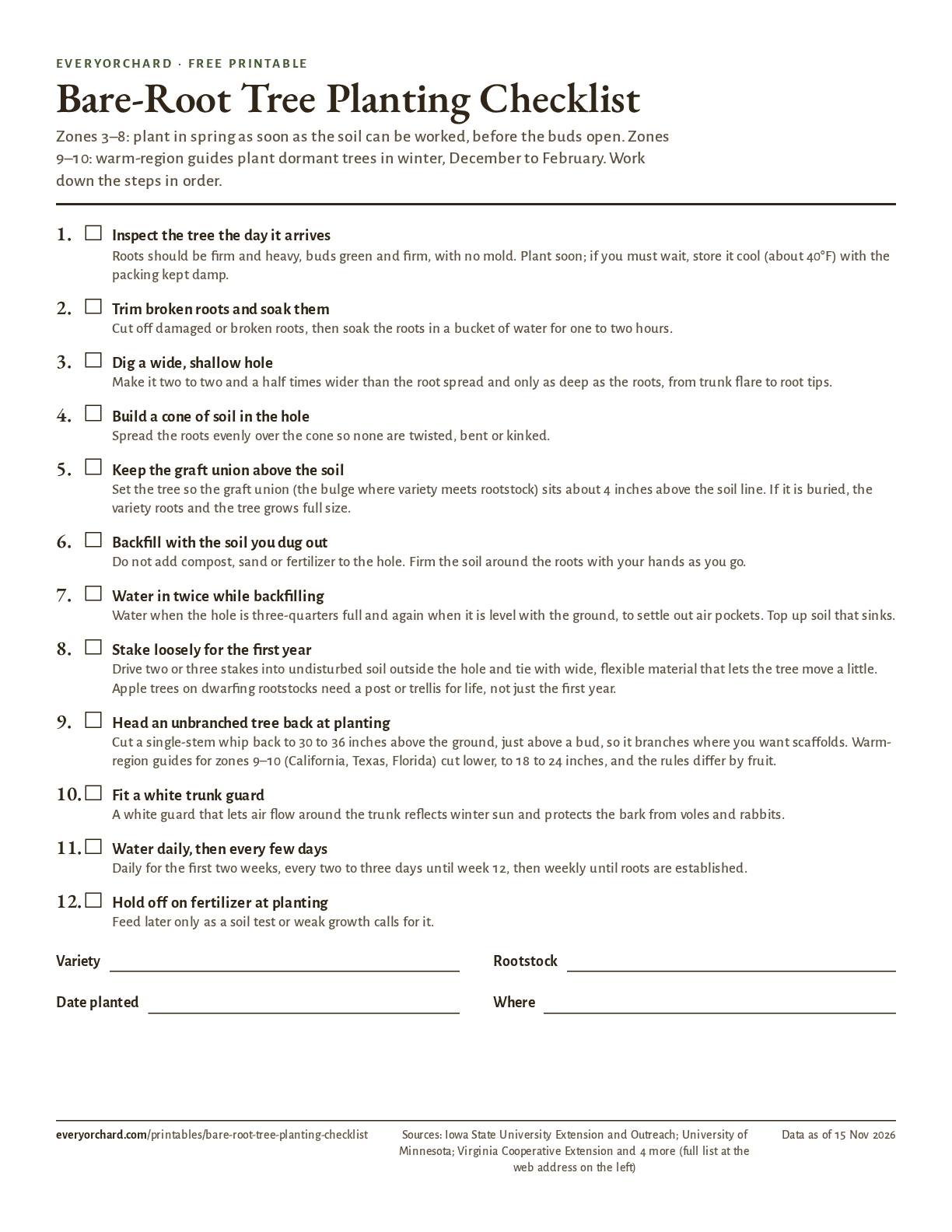
Zones 3–8: plant in spring as soon as the soil can be worked, before the buds open. Zones 9–10: warm-region guides plant dormant trees in winter, December to February. Work down the steps in order.
- Inspect the tree the day it arrives Roots should be firm and heavy, buds green and firm, with no mold. Plant soon; if you must wait, store it cool (about 40°F) with the packing kept damp.
- Trim broken roots and soak them Cut off damaged or broken roots, then soak the roots in a bucket of water for one to two hours.
- Dig a wide, shallow hole Make it two to two and a half times wider than the root spread and only as deep as the roots, from trunk flare to root tips.
- Build a cone of soil in the hole Spread the roots evenly over the cone so none are twisted, bent or kinked.
- Keep the graft union above the soil Set the tree so the graft union (the bulge where variety meets rootstock) sits about 4 inches above the soil line. If it is buried, the variety roots and the tree grows full size.
- Backfill with the soil you dug out Do not add compost, sand or fertilizer to the hole. Firm the soil around the roots with your hands as you go.
- Water in twice while backfilling Water when the hole is three-quarters full and again when it is level with the ground, to settle out air pockets. Top up soil that sinks.
- Stake loosely for the first year Drive two or three stakes into undisturbed soil outside the hole and tie with wide, flexible material that lets the tree move a little. Apple trees on dwarfing rootstocks need a post or trellis for life, not just the first year.
- Head an unbranched tree back at planting Cut a single-stem whip back to 30 to 36 inches above the ground, just above a bud, so it branches where you want scaffolds. Warm-region guides for zones 9–10 (California, Texas, Florida) cut lower, to 18 to 24 inches, and the rules differ by fruit.
- Fit a white trunk guard A white guard that lets air flow around the trunk reflects winter sun and protects the bark from voles and rabbits.
- Water daily, then every few days Daily for the first two weeks, every two to three days until week 12, then weekly until roots are established.
- Hold off on fertilizer at planting Feed later only as a soil test or weak growth calls for it.
Jobs as of November 15, 2026, from the same care library the site’s calendars use.
Use it with
Sources
Every figure on this printable comes from these sources.
- [1] Iowa State University Extension and Outreach. How to plant bare root trees — accessed November 2026
- [2] University of Minnesota Extension. Growing apples in the home garden — accessed November 2026
- [3] Virginia Cooperative Extension. Growing pears in Virginia (422-017) — accessed November 2026
- [4] Texas A&M AgriLife. When and how to plant fruit trees for 'fruitful' results — accessed November 2026
- [5] UF/IFAS Extension (University of Florida). Training and Pruning Florida Peaches, Nectarines, and Plums (HS1111) — accessed November 2026
- [6] University of California Agriculture and Natural Resources. Fruit Trees: Planting and Care — accessed November 2026
- [7] Virginia Cooperative Extension. Growing apples in Virginia (422-023) — accessed November 2026
- [8] Utah State University Extension. Training and pruning apple trees — accessed November 2026
- [9] University of Minnesota Extension. Growing pears in the home garden — accessed November 2026
- [10] Texas A&M AgriLife. How to plant fruit trees the Texas A&M AgriLife way — accessed November 2026
- [11] University of Minnesota Extension. Watering newly planted trees and shrubs — accessed November 2026