Orchard plan · Free PDF
Twelve-Tree Family Orchard Plan
Twelve semi-dwarf and standard fruit trees for a family: four apples, two pears, two peaches, two plums and two tart cherries, drawn to scale.
70 × 80 feet, 12 trees, every spacing from university extension figures. Print the plan, mark out the trees, then fill each spot from the picks for your zone.
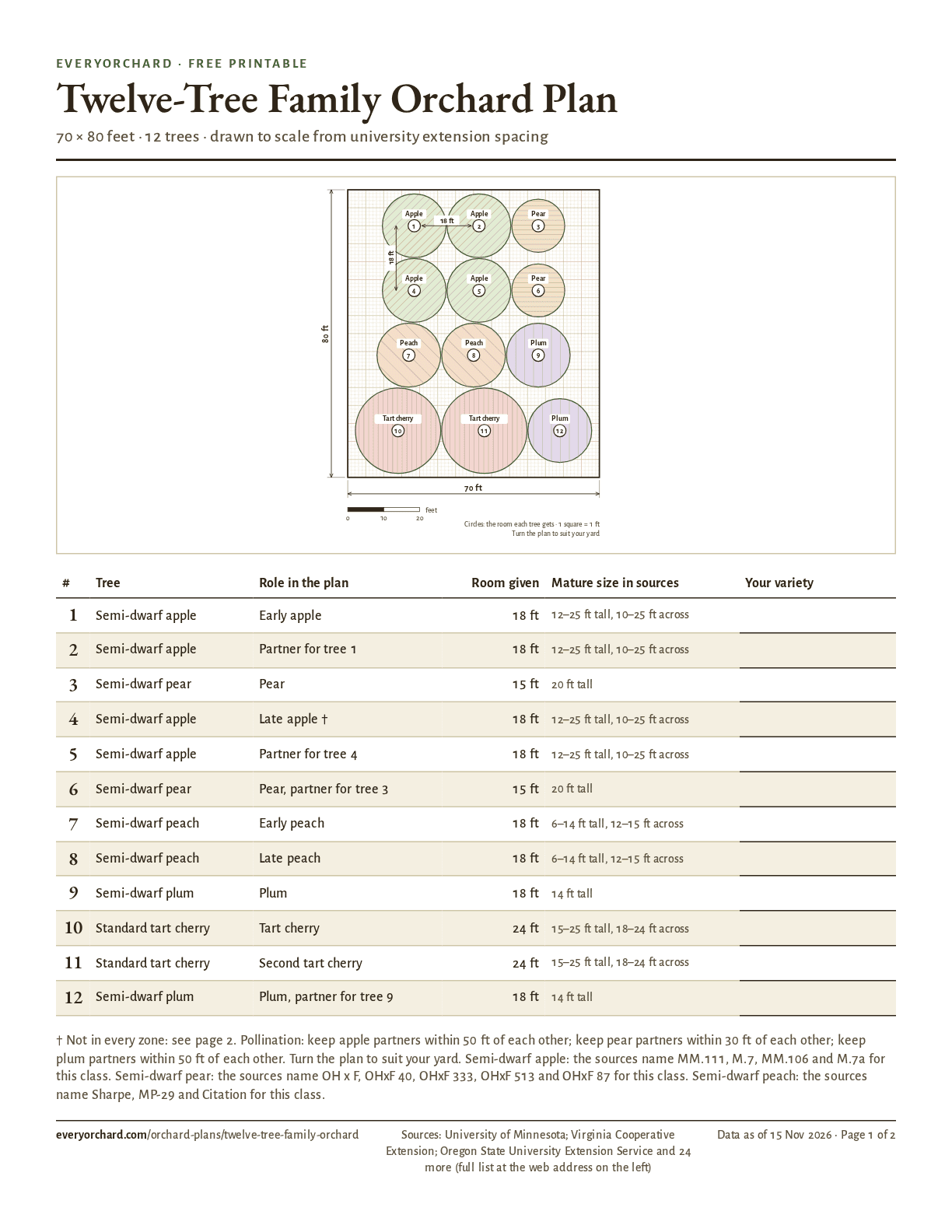
The plan, to scale
Each circle is the room that tree gets, from the spacing extension sources recommend for its size; each square is one foot. Turn the plan to suit your yard.
Why this plan works
Twelve semi-dwarf and standard trees give a family five kinds of fruit: four apples, two pears, two peaches, two plums and two tart cherries. Bigger trees need more room, so semi-dwarf apples, peaches and plums each get an 18 foot circle and the standard tart cherries 24 feet. Apples, pears and plums are planted in pairs because each needs a second variety. Peaches and tart cherries are self-fruitful, so their second trees widen the choice rather than help pollination.
Two apple pairs let one pair ripen early and the other late. With the zone 6 picks below, the harvest runs from May (Early Richmond) to November (Fuji).
Peaches bloom early and are especially at risk from spring frost, so give them the higher ground if the yard slopes, since cold air settles in low spots. The thing to get right is the plum pair: Japanese and European plums don't pollinate each other, so the two plums must be the same type.
What you need
- Space: 70 by 80 feet, about 5600 square feet.
- Trees: 4 semi-dwarf apples, 2 semi-dwarf pears, 2 semi-dwarf peaches, 2 semi-dwarf plums, 2 standard tart cherries.
- Sun: At least 6 hours of direct sun a day; some sources ask for 8.
- Apple partners: keep them within 50 feet of each other. Each pair here stands closer than that.
- Pear partners: keep them within 30 feet of each other. Each pair here stands closer than that.
- Plum partners: keep them within 50 feet of each other. Each pair here stands closer than that.
- Support: Sources differ on semi-dwarf apples: Iowa State says some need permanent support, while Utah State says trees on M.7 can stand on their own.
- Support: Stake young pears at planting; Minnesota says the stake can come out after a few years.
- Support: Plums need no permanent stake, says Maine; Utah State stakes bare-root plums for one year in windy places.
Plant list
| # | Tree | Role | Room given | Mature size in sources |
|---|---|---|---|---|
| 1 | Semi-dwarf apple | Early apple | 18 ft | 12–25 ft tall, 10–25 ft across |
| 2 | Semi-dwarf apple | Partner for tree 1 | 18 ft | 12–25 ft tall, 10–25 ft across |
| 3 | Semi-dwarf pear | Pear | 15 ft | 20 ft tall |
| 4 | Semi-dwarf apple | Late apple | 18 ft | 12–25 ft tall, 10–25 ft across |
| 5 | Semi-dwarf apple | Partner for tree 4 | 18 ft | 12–25 ft tall, 10–25 ft across |
| 6 | Semi-dwarf pear | Pear, partner for tree 3 | 15 ft | 20 ft tall |
| 7 | Semi-dwarf peach | Early peach | 18 ft | 6–14 ft tall, 12–15 ft across |
| 8 | Semi-dwarf peach | Late peach | 18 ft | 6–14 ft tall, 12–15 ft across |
| 9 | Semi-dwarf plum | Plum | 18 ft | 14 ft tall |
| 10 | Standard tart cherry | Tart cherry | 24 ft | 15–25 ft tall, 18–24 ft across |
| 11 | Standard tart cherry | Second tart cherry | 24 ft | 15–25 ft tall, 18–24 ft across |
| 12 | Semi-dwarf plum | Plum, partner for tree 9 | 18 ft | 14 ft tall |
- Semi-dwarf apple: the sources name MM.111, M.7, MM.106 and M.7a for this class.
- Semi-dwarf pear: the sources name OH x F, OHxF 40, OHxF 333, OHxF 513 and OHxF 87 for this class.
- Semi-dwarf peach: the sources name Sharpe, MP-29 and Citation for this class.
Variety picks for your zone
Every pick is a good fit for the zone by the site’s fit check (chill hours and cold hardiness at a typical location in that zone), and every tree that needs a partner has one in the plan whose bloom overlaps. Where the site’s data has no variety for a spot, the panel says so. Check your own ZIP with the variety fit tool.
Picks for zone 4
- 1
Early apple
Good fit for zone 4; bloom group 2, pollinated by Honeycrisp (tree 2) or Zestar (tree 5); early harvest, Jul–Aug.
Or: Lodi
- 2
Partner for tree 1
Good fit for zone 4; bloom group 3, pollinated by Yellow Transparent (tree 1) or Sweet Sixteen (tree 4) or Zestar (tree 5); harvest Sep–Oct.
Or: Lodi
- 3
- 4
Second apple
No late apple fits zone 4; this is the latest that does. Good fit for zone 4; bloom group 4, pollinated by Honeycrisp (tree 2) or Zestar (tree 5); harvest Sep–Oct.
Or: Lodi
- 5
Partner for tree 4
Good fit for zone 4; bloom group 3, pollinated by Yellow Transparent (tree 1) or Honeycrisp (tree 2) or Sweet Sixteen (tree 4); harvest Aug–Sep.
- 6
Pear, partner for tree 3
Good fit for zone 4; bloom group 2, pollinated by Golden Spice (tree 3); harvest Aug.
- 7
Early peach
No peach variety in the site's data is a good fit in zone 4.
- 8
Late peach
No peach variety in the site's data is a good fit in zone 4.
- 9
Plum
No good-fit plum varieties in zone 4 make a pollination pair here.
- 10
- 11
Second tart cherry
Zone 4 has too few good-fit tart cherry varieties in the site's data for this many trees.
- 12
Plum, partner for tree 9
Zone 4 has too few good-fit plum varieties in the site's data for this many trees.
Picks for zone 5
- 1
Early apple
Good fit for zone 5; bloom group 2, pollinated by Honeycrisp (tree 2) or Red Delicious (tree 4); early harvest, Jul–Aug.
- 2
Partner for tree 1
Good fit for zone 5; bloom group 3, pollinated by Yellow Transparent (tree 1) or Red Delicious (tree 4) or Fuji (tree 5); harvest Sep–Oct.
- 3
Pear
Good fit for zone 5; bloom group 2, pollinated by Golden Spice (tree 6); harvest Aug.
- 4
Late apple
Good fit for zone 5; bloom group 3, pollinated by Yellow Transparent (tree 1) or Honeycrisp (tree 2) or Fuji (tree 5); late harvest, Oct.
Or: Arkansas Black; GoldRush
- 5
Partner for tree 4
Good fit for zone 5; bloom group 4, pollinated by Honeycrisp (tree 2) or Red Delicious (tree 4); harvest Oct–Nov.
Or: Granny Smith; Lodi
- 6
Pear, partner for tree 3
Good fit for zone 5; bloom group 2, pollinated by Harrow Delight (tree 3); harvest Aug.
- 7
- 8
- 9
Plum
Good fit for zone 5; self-fruitful European plum; harvest Aug.
- 10
- 11
- 12
Plum, partner for tree 9
Good fit for zone 5; self-fruitful European plum; harvest Aug–Sep.
Picks for zone 6
- 1
Early apple
Good fit for zone 6; bloom group 2, pollinated by Empire (tree 2) or Red Delicious (tree 4); early harvest, Jul–Aug.
Or: Ginger Gold; Earligold
- 2
- 3
Pear
Good fit for zone 6; bloom group 2, pollinated by Summercrisp (tree 6); harvest Aug.
Or: D'Anjou; Golden Spice
- 4
Late apple
Good fit for zone 6; bloom group 3, pollinated by Yellow Transparent (tree 1) or Empire (tree 2) or Fuji (tree 5); late harvest, Oct.
Or: GoldRush; Northern Spy
- 5
Partner for tree 4
Good fit for zone 6; bloom group 4, pollinated by Empire (tree 2) or Red Delicious (tree 4); harvest Oct–Nov.
Or: Granny Smith; Akane
- 6
Pear, partner for tree 3
Good fit for zone 6; bloom group 2, pollinated by Harrow Delight (tree 3); harvest Aug.
Or: D'Anjou; Golden Spice
- 7
- 8
- 9
Plum
Good fit for zone 6; self-fruitful European plum; harvest Aug.
- 10
- 11
- 12
Plum, partner for tree 9
Good fit for zone 6; self-fruitful European plum; harvest Aug–Sep.
Picks for zone 7
- 1
Early apple
Good fit for zone 7; bloom group 2, pollinated by Acey Mac (tree 2); early harvest, Jul–Aug.
Or: Ginger Gold; Earligold
- 2
Partner for tree 1
Good fit for zone 7; bloom group 2, pollinated by Yellow Transparent (tree 1); harvest Sep–Oct.
Or: McIntosh; CandyCrisp
- 3
Pear
Good fit for zone 7; bloom group 2, pollinated by D'Anjou (tree 6); harvest Aug.
- 4
Late apple
Good fit for zone 7; bloom group 4, pollinated by Fuji (tree 5); late harvest, Oct.
Or: Cameo; CandyCrisp
- 5
Partner for tree 4
Good fit for zone 7; bloom group 4, pollinated by Rome Beauty (tree 4); harvest Oct–Nov.
Or: Granny Smith; Cameo
- 6
- 7
- 8
- 9
Plum
Good fit for zone 7; self-fruitful European plum; harvest Aug.
- 10
- 11
- 12
Plum, partner for tree 9
Good fit for zone 7; self-fruitful European plum; harvest Aug–Sep.
Picks for zone 8
- 1
Early apple
Good fit for zone 8; bloom group 2, pollinated by Empire (tree 2); early harvest, Jul–Aug.
Or: Ginger Gold
- 2
Partner for tree 1
Good fit for zone 8; bloom group 3, pollinated by Yellow Transparent (tree 1) or Rome Beauty (tree 4) or Fuji (tree 5); harvest Sep–Oct.
Or: McIntosh; Red Delicious
- 3
Pear
Good fit for zone 8; bloom group 3, pollinated by Hosui (tree 6); harvest Aug.
Or: Harrow Delight; D'Anjou
- 4
Late apple
Good fit for zone 8; bloom group 4, pollinated by Empire (tree 2) or Fuji (tree 5); late harvest, Oct.
- 5
Partner for tree 4
Good fit for zone 8; bloom group 4, pollinated by Empire (tree 2) or Rome Beauty (tree 4); harvest Oct–Nov.
- 6
Pear, partner for tree 3
Good fit for zone 8; bloom group 3, pollinated by 20th Century (tree 3); harvest Aug.
Or: Harrow Delight; D'Anjou
- 7
- 8
- 9
Plum
Good fit for zone 8; bloom group 3, pollinated by Flavor Grenade (tree 12); harvest Aug.
- 10
- 11
- 12
Plum, partner for tree 9
Good fit for zone 8; bloom group 3, pollinated by Dapple Dandy (tree 9); harvest Aug–Oct.
Picks for zone 9
- 1
Early apple
No apple variety in the site's data is a good fit in zone 9.
- 2
Partner for tree 1
No apple variety in the site's data is a good fit in zone 9.
- 3
- 4
Late apple
No apple variety in the site's data is a good fit in zone 9.
- 5
Partner for tree 4
No apple variety in the site's data is a good fit in zone 9.
- 6
Pear, partner for tree 3
Good fit for zone 9; bloom group 3, pollinated by Kieffer (tree 3); harvest Aug.
- 7
- 8
- 9
Plum
Good fit for zone 9; bloom group 3, pollinated by Satsuma (tree 12); harvest Jun–Jul.
- 10
Tart cherry
No tart cherry variety in the site's data is a good fit in zone 9.
- 11
Second tart cherry
No tart cherry variety in the site's data is a good fit in zone 9.
- 12
How to adapt the plan
- Keep each numbered partner next to the tree it pollinates; if you move one, keep the pair within the partner distance above.
- Some rootstocks, soils and training systems call for different spacing:
- Semi-dwarf apples in strong soils or for vigorous varieties: 16 ft apart (Virginia).
- Semi-dwarf apples in strong soils or for vigorous varieties: 14 ft apart (Virginia).
- Semi-dwarf apples on MM.106: 12–16 ft apart (NC State).
- Semi-dwarf apples on M.7a: 10–14 ft apart (NC State).
- Changing tree size changes the room each tree needs. From the same sources:
- Apple: dwarf 12 ft, semi-dwarf 18 ft, standard 30 ft apart.
- Pear: dwarf 15 ft, standard 25 ft apart.
- Peach: semi-dwarf 18 ft, standard 20 ft apart.
- Plum: semi-dwarf 18 ft, standard 20 ft apart.
- Tart Cherry: dwarf 15 ft, standard 24 ft apart.
- To swap a variety, choose another good fit for your ZIP, and for apples and pears check it against its partner with the pollination checker.
Spacing figures and sources
Each tree's circle is as wide as the widest spacing university extension sources recommend for home gardens for its size class as a whole, and neighboring circles touch, so two trees stand half of each one's spacing apart. A bigger size class never gets less room than a smaller one of the same fruit. Figures for one rootstock, soil or training system are listed under How to adapt the plan.
Semi-dwarf apple: 18 ft for each tree
| Source | Height | Spread | Spacing | What it says |
|---|---|---|---|---|
| University of Minnesota | — | — | 12–15 ftsets the plan | From the table in Growing apples in the home garden. |
| University of MinnesotaMM.111 | 14–18 ft | — | — | “MM.111: This rootstock, termed 'semi-dwarfing' or 'semi-standard,' produces a tree about 80% of the height of a standard tree. In many areas of Minnesota, this can work out to roughly a 14- to 18-foot tree.” |
| VirginiaMM.111 | 16–20 ft | — | 18 ft | From the table in Growing Apples in Virginia (422-023). |
| VirginiaM.7 | 16–18 ft | — | 16 ft | From the table in Growing Apples in Virginia (422-023). |
| VirginiaMM.106 | 14–16 ft | — | 14 ft | From the table in Growing Apples in Virginia (422-023). |
| Virginia | — | — | 18 ftsets the plan | From the table in Tree Fruit in the Home Garden (426-841). |
| VirginiaMM.111 | 16–18 ft | — | — | “the same variety of apple will produce a 16- to 18-foot tree on the rootstock Malling Merton (MM)111” |
| Oregon State UniversityMM-106, MM-111, M-7 | 15–25 ft | 15–25 ft | — | From the table in Growing tree fruits and nuts at home (EC 819). |
| Colorado State University | 12–15 ft | 10 ft | — | From the table in Growing Tree Fruit in Colorado Gardens. |
| Iowa State University | 15 ft | — | 10–16 ftsets the plan | “Semi-dwarf rootstocks produce trees about 15 feet tall. … those on a semi-dwarf rootstock can be spaced 10 to 16 feet apart” |
| Utah State UniversityM.7 | 15–20 ft | 15–20 ft | — | “Semi-dwarf trees on M.7 rootstock (a common rootstock for trees destined for home gardeners) can be grown free standing and are more suitable for most home garden situations. … M.7 Very common rootstock for home use. Trees reach 15-20 feet high and wide at maturity.” |
| NC StateMM.111 | — | — | 14–18 ft | From the table in Extension Gardener Handbook, 15. Tree Fruit and Nuts. |
| NC StateMM.106 | — | — | 12–16 ft | From the table in Extension Gardener Handbook, 15. Tree Fruit and Nuts. |
| NC StateM.7a | — | — | 10–14 ft | From the table in Extension Gardener Handbook, 15. Tree Fruit and Nuts. |
Semi-dwarf pear: 15 ft for each tree
| Source | Height | Spread | Spacing | What it says |
|---|---|---|---|---|
| University of MinnesotaOH x F | 20 ft | — | — | “Semi-dwarfing rootstocks for hardy pears are often from the Old Home x Farmingdale series, or OH x F. If you find a tree grafted onto this rootstock you can be very sure it will survive in Minnesota and produce a tree that tops out at about 20 feet tall.” |
| University of New HampshireOHxF 40, OHxF 333, OHxF 513, OHxF 87 | — | — | 12 ft | “Pear varieties grafted onto these semi-dwarfing rootstocks should produce trees about 2/3 the size of standard trees. In addition, these semi-dwarf pear trees will produce fruit earlier in life. Examples of these semi-dwarf rootstocks are OHxF 40, OHxF 333, OHxF 513 and OHxF 87. … Space semi-dwarf pear trees 12 feet apart in the home orchard.” |
Semi-dwarf peach: 18 ft for each tree
| Source | Height | Spread | Spacing | What it says |
|---|---|---|---|---|
| University of GeorgiaSharpe, MP-29 | — | 12–15 ft | — | “Peach trees on Sharpe and on MP-29 rootstocks (semi-dwarf) will spread 12-15 feet, while standard trees will be twice the size (such as in Guardian, Halford, and Nemaguard rootstocks).” |
| Washington State UniversityCitation | 6–8 ft | — | — | From the table in Fruit Handbook for Western Washington (EB0937). |
| UC Cooperative Extension Contra CostaCitation | 8–14 ft | — | — | From the table in Fruit Tree Selection and Planting. |
| University of Arizona | — | — | 15–18 ftsets the plan | “Semi-dwarf apples, peaches, apricots, and plums should be about 15-18 ft apart” |
Semi-dwarf plum: 18 ft for each tree
| Source | Height | Spread | Spacing | What it says |
|---|---|---|---|---|
| University of Arizona | — | — | 15–18 ftsets the plan | “Semi-dwarf apples, peaches, apricots, and plums should be about 15-18 ft apart” |
| UConn Home & Garden Education Center | 14 ft | — | 10 ftsets the plan | “or semi-dwarfs, reaching only about 14 feet. … Semi-dwarfs can be planted about 10 feet apart” |
Standard tart cherry: 24 ft for each tree
| Source | Height | Spread | Spacing | What it says |
|---|---|---|---|---|
| Colorado State University | 15 ft | 18–24 ft | — | From the table in Growing Tree Fruit in Colorado Gardens. |
| Kansas State University | — | — | 20 ftsets the plan | From the table in MF352: Planning Your Fruit Garden. |
| Purdue University | — | — | 20–24 ftsets the plan | “Traditionally, cherry trees grew very large and had to be planted far apart to allow for their full size. Tree spacing was 20-24 feet apart for tart cherries and 25-30 feet apart for sweet cherries.” |
| University of Saskatchewan | 15–25 ft | — | — | “True sour cherries are large trees, up to 5-8m (15-25 feet) tall with larger tart to semi-sweet fruit” |
Next steps
Sources
Every spacing figure on this page comes from these extension sources, and the variety picks from the site's variety data and its sources.
- [1] University of Minnesota Extension. Growing apples in the home garden — accessed November 2026
- [2] Virginia Cooperative Extension. Growing Apples in Virginia (422-023) — accessed November 2026
- [3] Virginia Cooperative Extension. Tree Fruit in the Home Garden (426-841) — accessed November 2026
- [4] Oregon State University Extension Service. Growing tree fruits and nuts at home (EC 819) — accessed November 2026
- [5] Colorado State University Extension. Growing Tree Fruit in Colorado Gardens — accessed November 2026
- [6] Iowa State University Extension and Outreach. Growing Apples in the Home Garden — accessed November 2026
- [7] Utah State University Extension. Apple Production and Variety Recommendations for the Utah Home Garden — accessed November 2026
- [8] NC State Extension. Extension Gardener Handbook, 15. Tree Fruit and Nuts — accessed November 2026
- [9] University of Minnesota Extension. Growing pears in the home garden — accessed November 2026
- [10] University of New Hampshire Extension. Growing Fruits: Growing Pears in the Home Orchard [fact sheet] — accessed November 2026
- [11] Kansas State University Research and Extension. Planning Your Fruit Garden (MF352) — accessed November 2026
- [12] Virginia Cooperative Extension (Virginia Tech). Tree Fruit in the Home Garden (Relf and Marini, archived scan) — accessed November 2026
- [13] University of Georgia Cooperative Extension. Home Garden Peaches (C1063) — accessed November 2026
- [14] Washington State University Extension. Fruit Handbook for Western Washington (EB0937) — accessed November 2026
- [15] UC Cooperative Extension Contra Costa (Master Gardener presentation). Fruit Tree Selection and Planting — accessed November 2026
- [16] University of Arizona Cooperative Extension, Yavapai County. Home Orchard Care for Master Gardeners — accessed November 2026
- [17] UConn Home & Garden Education Center. Plums — accessed November 2026
- [18] Colorado State University Extension. Growing Tree Fruit in Colorado Gardens — accessed November 2026
- [19] Kansas State University Research and Extension. MF352: Planning Your Fruit Garden — accessed November 2026
- [20] Purdue University Extension. HO-9-W: Cherries — accessed November 2026
- [21] University of Saskatchewan (Gardening at USask). Sour Cherries — accessed November 2026
- [22] University of Saskatchewan, Gardening at USask. Apples — accessed November 2026
- [23] The Ohio State University Extension (Bulletin 940), hosted by Purdue Extension Vigo County. Midwest Home Fruit Production Guide (Bulletin 940) — accessed November 2026
- [24] Virginia Cooperative Extension. Growing Apples in Virginia (422-023) — accessed November 2026
- [25] University of Maryland Extension. Starting a Home Fruit Garden — accessed November 2026
- [26] Virginia Cooperative Extension. Growing Pears in Virginia (422-017) — accessed November 2026
- [27] Virginia Cooperative Extension (Virginia Tech). Growing Pears in Virginia (422-017) — accessed November 2026
- [28] University of Kentucky Cooperative Extension. Growing Tree Fruits (HO-104) — accessed November 2026
- [29] Colorado State University Extension. Growing Tree Fruit in Colorado Gardens — accessed November 2026
- [30] University of Arkansas Cooperative Extension Service. Pear Production in the Home Garden (FSA6059) — accessed November 2026
- [31] University of Idaho College of Agriculture (Current Information Series, 1991 scan). Pears in the Home Garden (Current Information Series) — accessed November 2026
- [32] Colorado State University Extension. Growing Tree Fruit in Colorado Gardens — accessed November 2026
- [33] Virginia Cooperative Extension. Tree Fruit in the Home Garden (426-841) — accessed November 2026
- [34] NC State Extension. Extension Gardener Handbook, 15. Tree Fruit and Nuts — accessed November 2026
- [35] Iowa State University Extension and Outreach. Growing Cherries in the Home Garden — accessed November 2026
- [36] NC State Extension. Extension Gardener Handbook, Chapter 15: Tree Fruit and Nuts — accessed November 2026
- [37] Clemson Cooperative Extension Home & Garden Information Center. Plum — accessed November 2026
- [38] Dave Wilson Nursery. Apples — DWN Variety Finder product list — accessed July 2026
- [39] University of Minnesota (Minnesota Hardy / Horticultural Research Center). All University of Minnesota Apple Varieties — Minnesota Hardy — accessed July 2026
- [40] Utah State University Extension. Apple Production and Variety Recommendations for the Utah Home Garden — accessed July 2026
- [41] Dave Wilson Nursery. Cherries — DWN Variety Finder product list — accessed July 2026
- [42] Dave Wilson Nursery. Cherries, Sour — DWN Variety Finder product list — accessed July 2026
- [43] Dave Wilson Nursery. Early Richmond Sour Cherry — DWN Variety Finder — accessed November 2026
- [44] Raintree Nursery. Balaton Cherry — variety page — accessed July 2026
- [45] University of Minnesota (UFOR Nursery & Lab). Evans Bali Cherry — Prunus cerasus 'Evans Bali' — accessed July 2026
- [46] Utah State University Extension (Intermountain Tree Fruit Production Guide). Varieties for Utah — Cherry — accessed July 2026
- [47] Dave Wilson Nursery. Asian pears — DWN Variety Finder product list — accessed July 2026
- [48] Dave Wilson Nursery. Hosui Asian pear — variety specifications — accessed July 2026
- [49] Dave Wilson Nursery. European pears — DWN Variety Finder product list — accessed July 2026
- [50] Washington State University Tree Fruit. Pollination — Pear (WSU Tree Fruit) — accessed July 2026
- [51] Dave Wilson Nursery. Dapple Dandy Pluot — DWN Variety Finder — accessed July 2026
- [52] Dave Wilson Nursery. Flavor Grenade Pluot — DWN Variety Finder — accessed July 2026
- [53] Dave Wilson Nursery. Italian Prune — variety specifications — accessed July 2026
- [54] Dave Wilson Nursery. Santa Rosa Plum — DWN Variety Finder — accessed July 2026
- [55] Dave Wilson Nursery. Satsuma Plum — DWN Variety Finder — accessed July 2026
- [56] Dave Wilson Nursery. Stanley Prune — variety specifications — accessed July 2026
- [57] University of Missouri Extension. Pollinating Fruit Crops (G6001) — accessed November 2026
- [58] Dave Wilson Nursery. Peaches — DWN Variety Finder product list — accessed July 2026
- [59] Raintree Nursery. Reliance Peach — variety page — accessed July 2026
- [60] University of Georgia Extension (CAES). Home Garden Peaches (Circular 1063) — accessed July 2026
- [61] University of Minnesota Extension. Growing apples in the home garden — accessed July 2026
- [62] University of Minnesota Extension. Growing pears in the home garden — accessed July 2026
- [63] University of Minnesota. Honeycrisp — Minnesota Hardy (U of M fruit breeding program) — accessed July 2026