Plum variety
Santa Rosa
Also known as Santa Rosa Plum
Growing facts
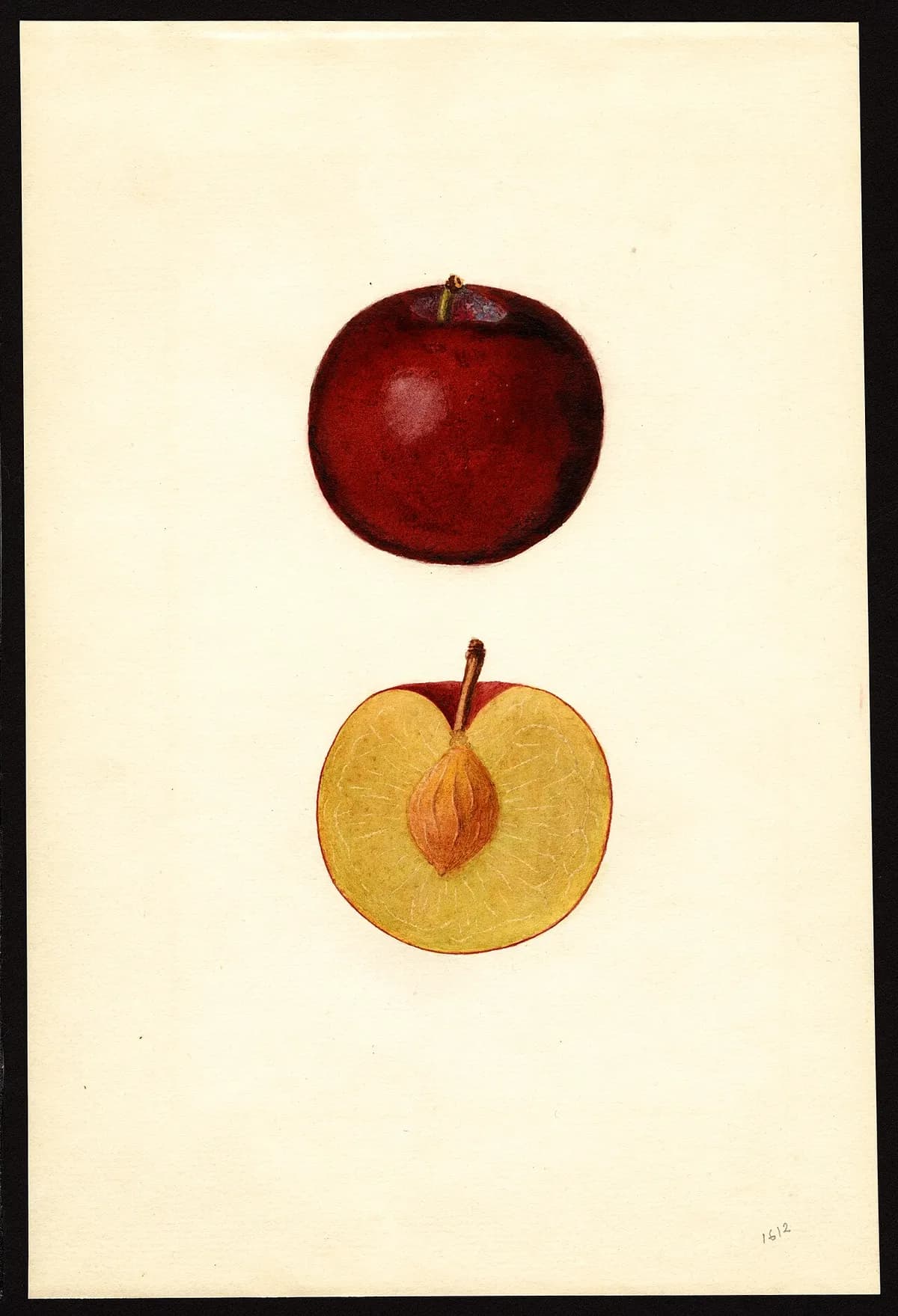
Plate provenance[3]
Notes
- Japanese-type plum (Prunus salicina); self-fruitful and a widely used pollinizer for other Japanese plums.[1]
- Japanese plums must be pollinated by another Japanese variety; European and Japanese types cannot cross-pollinate.[4]
- Brown rot is the most common disease of plums; fungicides labeled for peach brown rot can be used on plums.[4]
A year with your Santa Rosa
When the work happens for a plum in USDA zone 6, anchored to typical frost dates.
| Task | J | F | M | A | M | J | J | A | S | O | N | D |
|---|---|---|---|---|---|---|---|---|---|---|---|---|
| Prune | — | — | — | — | — | — | — | — | — | — | ||
| Thin | — | — | — | — | — | — | — | — | — | — | — | |
| Spray timing | — | — | — | — | — | — | ||||||
| Harvest | — | — | — | — | — | — | — | — | ||||
| Care | — | — | — | — | — | — | — | — | — | — | — |
Can I grow Santa Rosa where I live?
Check the verdict for a few regions, or your exact ZIP:
Growing a Santa Rosa? Get its care calendar for your exact ZIP code, with email reminders.
Save this tree in My OrchardQuestions
- How many chill hours does Santa Rosa need?
- Santa Rosa needs 300 chill hours.
- Is Santa Rosa self-pollinating?
- Santa Rosa is self-fertile, though a pollination partner can improve cropping.
Sources
- [1] Dave Wilson Nursery. Santa Rosa Plum — DWN Variety Finder — accessed July 2026
- [2] Iowa State University Extension and Outreach. How soon will a newly planted fruit tree begin to bear fruit? (Yard and Garden FAQ) — accessed July 2026
- [3] USDA National Agricultural Library. USDA Pomological Watercolor Collection (Rare and Special Collections, 1886-1942) — accessed July 2026
- [4] Clemson Cooperative Extension (Home & Garden Information Center). Plum (HGIC 1362) — accessed July 2026