Orchard plan · Free PDF
Patio Orchard Plan in Five Pots
Five fruit trees in pots for a patio: two very dwarf apples, a fig and two citrus, each pot sized from university extension minimums.
10 × 10 feet, 5 trees, every spacing from university extension figures. Print the plan, mark out the trees, then fill each spot from the picks for your zone.
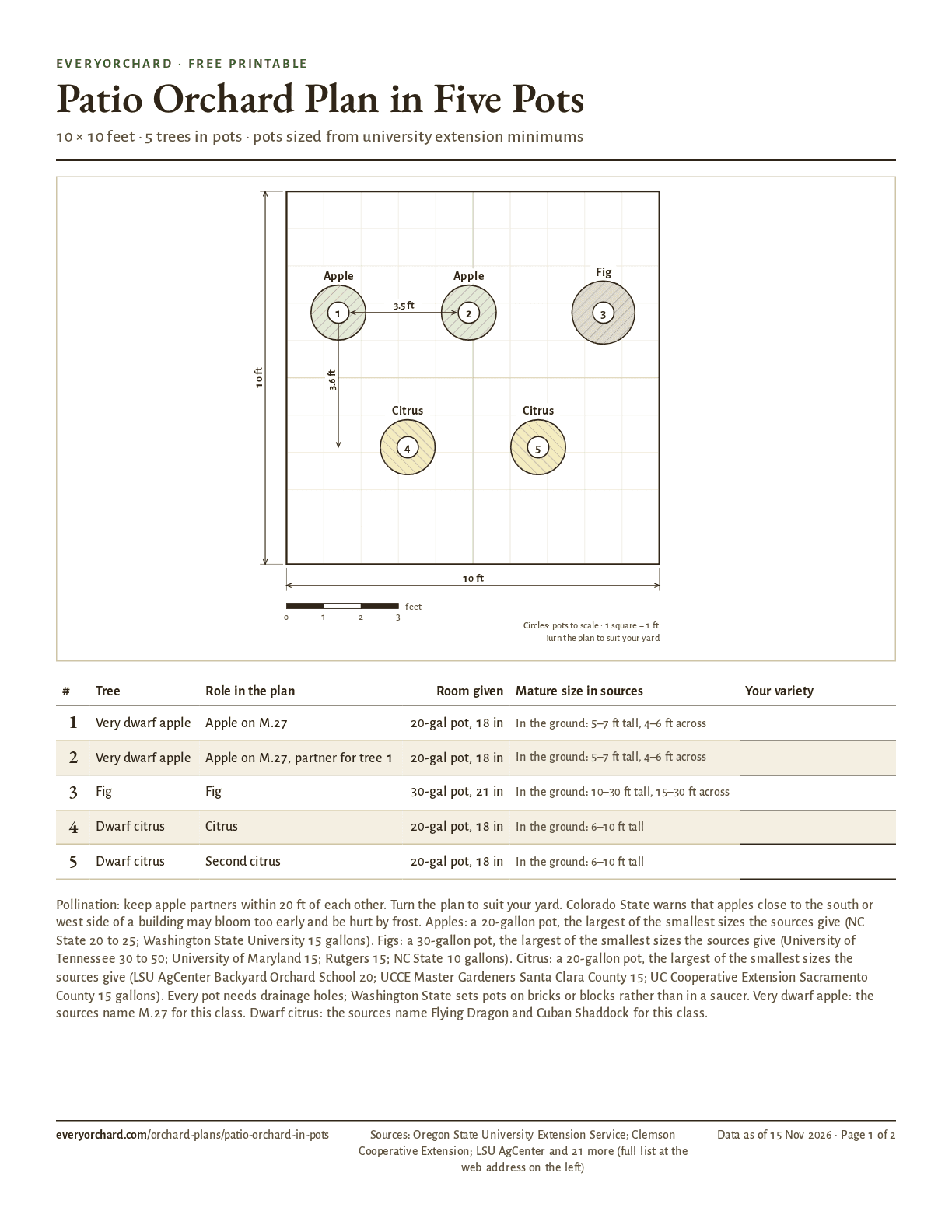
The plan, to scale
Each circle is a pot at the largest of the smallest sizes its fruit's sources give, drawn as a round pot as wide as it is deep; each square is one foot. No source gives a gap between pots: the 2 feet between them is room to reach each one. Turn the plan to suit your yard.
Why this plan works
This plan is for a patio or deck: five trees in pots, two apples, a fig and two citrus, grouped in a 10 by 10 foot space. Only dwarf trees or trees on very dwarfing rootstocks suit containers, since semi-dwarf trees are too vigorous, and Washington State names M.27, a true dwarf rootstock, for apples in pots. Most fig cultivars do well in containers in full sun, and the smaller citrus types, such as lemons, limes and kumquats, are best suited to them.
The two apples pollinate each other, and most citrus cultivars fruit as a single tree. With the zone 6 picks below, the harvest runs from July (Yellow Transparent) to November (Violette de Bordeaux).
Each pot is 20 to 30 gallons, the largest of the smallest sizes its fruit's sources give, so check that the deck or patio can hold the weight. Where winters are cold, the fig goes into an unheated garage or basement after a hard frost and the citrus comes under cover in freezes. The thing to get right is drainage: every pot needs holes in the bottom, set on bricks or blocks rather than in a saucer.
What you need
- Space: 10 by 10 feet, about 100 square feet.
- Trees: 2 very dwarf apples, 1 fig, 2 dwarf citrus.
- Sun: At least 6 hours of direct sun a day; some sources ask for 8.
- Apple partners: keep them within 20 feet of each other. Each pair here stands closer than that.
- Apples: a 20-gallon pot, the largest of the smallest sizes the sources give (NC State 20 to 25; Washington State University 15 gallons).
- Figs: a 30-gallon pot, the largest of the smallest sizes the sources give (University of Tennessee 30 to 50; University of Maryland 15; Rutgers 15; NC State 10 gallons).
- Citrus: a 20-gallon pot, the largest of the smallest sizes the sources give (LSU AgCenter Backyard Orchard School 20; UCCE Master Gardeners Santa Clara County 15; UC Cooperative Extension Sacramento County 15 gallons).
- Every pot needs drainage holes; Washington State sets pots on bricks or blocks rather than in a saucer.
- Siting: Colorado State warns that apples close to the south or west side of a building may bloom too early and be hurt by frost.
- Support: Apples on M.27 need support, says New Mexico State.
Plant list
| # | Tree | Role | Room given | Mature size in sources |
|---|---|---|---|---|
| 1 | Very dwarf apple | Apple on M.27 | 20-gal pot, 18 in | In the ground: 5–7 ft tall, 4–6 ft across |
| 2 | Very dwarf apple | Apple on M.27, partner for tree 1 | 20-gal pot, 18 in | In the ground: 5–7 ft tall, 4–6 ft across |
| 3 | Fig | Fig | 30-gal pot, 21 in | In the ground: 10–30 ft tall, 15–30 ft across |
| 4 | Dwarf citrus | Citrus | 20-gal pot, 18 in | In the ground: 6–10 ft tall |
| 5 | Dwarf citrus | Second citrus | 20-gal pot, 18 in | In the ground: 6–10 ft tall |
- Very dwarf apple: the sources name M.27 for this class.
- Dwarf citrus: the sources name Flying Dragon and Cuban Shaddock for this class.
Variety picks for your zone
Every pick is a good fit for the zone by the site’s fit check (chill hours and cold hardiness at a typical location in that zone), and every tree that needs a partner has one in the plan whose bloom overlaps. Where the site’s data has no variety for a spot, the panel says so. Check your own ZIP with the variety fit tool.
Picks for zone 4
- 1
Apple on M.27
Good fit for zone 4; bloom group 2, pollinated by Honeycrisp (tree 2); harvest Jul–Aug.
- 2
Apple on M.27, partner for tree 1
Good fit for zone 4; bloom group 3, pollinated by Yellow Transparent (tree 1); harvest Sep–Oct.
- 3
Fig
In zone 4 a potted fig has to spend winter under cover: Penn State moves potted figs into an unheated garage or basement after a hard frost. The site's fit check is for trees outdoors and doesn't cover trees wintered indoors, so no variety is picked.
- 4
Citrus
In zone 4 potted citrus has to come under cover in freezes: LSU moves potted citrus into a garage, porch or other spot that stays above freezing. The site's fit check is for trees outdoors and doesn't cover trees wintered indoors, so no variety is picked.
- 5
Second citrus
In zone 4 potted citrus has to come under cover in freezes: LSU moves potted citrus into a garage, porch or other spot that stays above freezing. The site's fit check is for trees outdoors and doesn't cover trees wintered indoors, so no variety is picked.
Picks for zone 5
- 1
Apple on M.27
Good fit for zone 5; bloom group 2, pollinated by Honeycrisp (tree 2); harvest Jul–Aug.
Or: Lodi; Sweet Sixteen
- 2
Apple on M.27, partner for tree 1
Good fit for zone 5; bloom group 3, pollinated by Yellow Transparent (tree 1); harvest Sep–Oct.
Or: Lodi; Red Delicious
- 3
Fig
Good fit for zone 5; self-fruitful; harvest Aug–Nov. One nursery rates Violette de Bordeaux to zone 5, its coldest; in a pot it still winters under cover: Penn State moves potted figs into an unheated garage or basement after a hard frost.
- 4
Citrus
In zone 5 potted citrus has to come under cover in freezes: LSU moves potted citrus into a garage, porch or other spot that stays above freezing. The site's fit check is for trees outdoors and doesn't cover trees wintered indoors, so no variety is picked.
- 5
Second citrus
In zone 5 potted citrus has to come under cover in freezes: LSU moves potted citrus into a garage, porch or other spot that stays above freezing. The site's fit check is for trees outdoors and doesn't cover trees wintered indoors, so no variety is picked.
Picks for zone 6
- 1
Apple on M.27
Good fit for zone 6; bloom group 2, pollinated by Empire (tree 2); harvest Jul–Aug.
Or: Red Delicious; Akane
- 2
Apple on M.27, partner for tree 1
Good fit for zone 6; bloom group 3, pollinated by Yellow Transparent (tree 1); harvest Sep–Oct.
Or: Red Delicious; Akane
- 3
- 4
Citrus
In zone 6 potted citrus has to come under cover in freezes: LSU moves potted citrus into a garage, porch or other spot that stays above freezing. The site's fit check is for trees outdoors and doesn't cover trees wintered indoors, so no variety is picked.
- 5
Second citrus
In zone 6 potted citrus has to come under cover in freezes: LSU moves potted citrus into a garage, porch or other spot that stays above freezing. The site's fit check is for trees outdoors and doesn't cover trees wintered indoors, so no variety is picked.
Picks for zone 7
- 1
Apple on M.27
Good fit for zone 7; bloom group 2, pollinated by Acey Mac (tree 2); harvest Jul–Aug.
Or: McIntosh; CandyCrisp
- 2
Apple on M.27, partner for tree 1
Good fit for zone 7; bloom group 2, pollinated by Yellow Transparent (tree 1); harvest Sep–Oct.
Or: McIntosh; CandyCrisp
- 3
- 4
Citrus
In zone 7 potted citrus has to come under cover in freezes: LSU moves potted citrus into a garage, porch or other spot that stays above freezing. The site's fit check is for trees outdoors and doesn't cover trees wintered indoors, so no variety is picked.
- 5
Second citrus
In zone 7 potted citrus has to come under cover in freezes: LSU moves potted citrus into a garage, porch or other spot that stays above freezing. The site's fit check is for trees outdoors and doesn't cover trees wintered indoors, so no variety is picked.
Picks for zone 8
- 1
Apple on M.27
Good fit for zone 8; bloom group 2, pollinated by Empire (tree 2); harvest Jul–Aug.
Or: Rome Beauty; McIntosh
- 2
Apple on M.27, partner for tree 1
Good fit for zone 8; bloom group 3, pollinated by Yellow Transparent (tree 1); harvest Sep–Oct.
Or: McIntosh; Red Delicious
- 3
Fig
Good fit for zone 8; self-fruitful; harvest Aug–Nov.
- 4
Citrus
In zone 8 potted citrus has to come under cover in freezes: LSU moves potted citrus into a garage, porch or other spot that stays above freezing. The site's fit check is for trees outdoors and doesn't cover trees wintered indoors, so no variety is picked.
- 5
Second citrus
In zone 8 potted citrus has to come under cover in freezes: LSU moves potted citrus into a garage, porch or other spot that stays above freezing. The site's fit check is for trees outdoors and doesn't cover trees wintered indoors, so no variety is picked.
Picks for zone 9
- 1
Apple on M.27
No apple variety in the site's data is a good fit in zone 9.
- 2
Apple on M.27, partner for tree 1
No apple variety in the site's data is a good fit in zone 9.
- 3
- 4
Citrus
Good fit for zone 9; self-fruitful; harvest Oct–Dec. Rated by type: extension sources say satsumas survive about 15°F (the middle of their figures), and zone 8b is the coldest zone whose coldest nights stay above that. Zone 9 gets freezes, so potted Owari Satsuma comes under cover in a freeze: LSU moves potted citrus into a garage, porch or other spot that stays above freezing.
- 5
Second citrus
Good fit for zone 9; self-fruitful; harvest Oct–Dec. Rated by type: extension sources say satsumas survive about 15°F (the middle of their figures), and zone 8b is the coldest zone whose coldest nights stay above that. Zone 9 gets freezes, so potted Satsuma Mandarin comes under cover in a freeze: LSU moves potted citrus into a garage, porch or other spot that stays above freezing.
How to adapt the plan
- Keep each numbered partner next to the tree it pollinates; if you move one, keep the pair within the partner distance above.
- Changing tree size changes the room each tree needs. From the same sources:
- Apple: dwarf 12 ft, semi-dwarf 18 ft, standard 30 ft apart.
- Citrus: dwarf 10 ft, standard 12 ft apart.
- To swap a variety, choose another good fit for your ZIP, and for apples and pears check it against its partner with the pollination checker.
Spacing figures and sources
Each tree's circle is as wide as the widest spacing university extension sources recommend for home gardens for its size class as a whole, and neighboring circles touch, so two trees stand half of each one's spacing apart. A bigger size class never gets less room than a smaller one of the same fruit. Figures for one rootstock, soil or training system are listed under How to adapt the plan.
Very dwarf apple: 0 ft for each tree
| Source | Height | Spread | Spacing | What it says |
|---|---|---|---|---|
| Oregon State UniversityM-27 | 5–7 ft | 4–6 ft | — | From the table in Growing tree fruits and nuts at home (EC 819). |
Fig: 16 ft for each tree
| Source | Height | Spread | Spacing | What it says |
|---|---|---|---|---|
| Clemson Cooperative Extension Home & Garden Information Center | 15–30 ft | 15–30 ft | — | From the table in Figs: How to Grow and Care for Figs in South Carolina. |
| LSU AgCenter | 10–30 ft | 15 ft | — | “The trees are deciduous, typically growing 10 to 30 feet tall, with branches spreading wider than their height. … Ensure they have enough space to grow, as they can reach more than 15 feet in height and width.” |
| University of Arizona | 10–30 ft | — | — | “Fig trees can get very large, 10 to 30ft tall and can be wider than they are tall.” |
| Texas A&M AgriLife | 20 ft | — | 16 ftsets the plan | “Because the trees can reach 20 feet tall, plant them no closer than 16 feet apart.” |
| University of Florida IFAS | 25 ft | — | 10–16 ftsets the plan | “in the southeastern United States, this tree is seldom taller than 25 feet due to periodic cold injury … The spacing of 10-16 ft (3-5 m) between plants and 13-20 ft (4-6 m) between rows is used for orchards, and similar spacing should be maintained for dooryard trees” |
| University of Maryland | — | — | 10 ftsets the plan | “Space plants at least 10 feet apart in each direction. Plant size can be controlled through pruning.” |
Dwarf citrus: 10 ft for each tree
| Source | Height | Spread | Spacing | What it says |
|---|---|---|---|---|
| UC Cooperative Extension Sacramento County | 6–10 ft | — | 8–10 ftsets the plan | From the table in Garden Notes GN 127: Growing citrus in Sacramento. |
| University of ArizonaFlying Dragon, Cuban Shaddock | 8 ft | — | — | “Dwarf: Flying Dragon, Cuban Shaddock. (less than 8 ft)” |
| LSU AgCenter Backyard Orchard SchoolFlying Dragon | 8–10 ft | — | — | From the table in Citrus Module 1.8 Rootstocks and dwarf citrus. |
| AlabamaFlying Dragon | — | — | 10 ft | “Satsumas on Flying Dragon can be spaced closer in the row (~ 10 feet apart).” |
Next steps
Sources
Every spacing figure on this page comes from these extension sources, and the variety picks from the site's variety data and its sources.
- [1] Oregon State University Extension Service. Growing tree fruits and nuts at home (EC 819) — accessed November 2026
- [2] Clemson Cooperative Extension Home & Garden Information Center. Figs: How to Grow and Care for Figs in South Carolina — accessed November 2026
- [3] LSU AgCenter. Fig harvest and care article — accessed November 2026
- [4] University of Arizona Cooperative Extension. Growing Common Figs in the Low Desert — accessed November 2026
- [5] Texas A&M AgriLife Extension. Texas Fruit and Nut Production: Figs — accessed November 2026
- [6] University of Florida IFAS Extension (EDIS). MG214 The Fig: Botany, Production and Uses / fig in Florida — accessed November 2026
- [7] University of Maryland Extension. Growing Figs in Maryland — accessed November 2026
- [8] UC Cooperative Extension Sacramento County. Garden Notes GN 127: Growing citrus in Sacramento — accessed November 2026
- [9] University of Arizona Cooperative Extension. Small Scale Citrus Farming - 2022 (Glenn C. Wright, presentation) — accessed November 2026
- [10] LSU AgCenter Backyard Orchard School. Citrus Module 1.8 Rootstocks and dwarf citrus — accessed November 2026
- [11] Alabama Cooperative Extension (hosted by UGA Extension Worth County). Satsuma information (Alabama) — accessed November 2026
- [12] University of Minnesota Extension. Growing apples in the home garden — accessed November 2026
- [13] Virginia Cooperative Extension. Growing Apples in Virginia (422-023) — accessed November 2026
- [14] University of Saskatchewan, Gardening at USask. Apples — accessed November 2026
- [15] Colorado State University Extension. Growing Tree Fruit in Colorado Gardens — accessed November 2026
- [16] The Ohio State University Extension (Bulletin 940), hosted by Purdue Extension Vigo County. Midwest Home Fruit Production Guide (Bulletin 940) — accessed November 2026
- [17] Virginia Cooperative Extension. Growing Apples in Virginia (422-023) — accessed November 2026
- [18] University of Maryland Extension. Starting a Home Fruit Garden — accessed November 2026
- [19] Colorado State University Extension (PlantTalk Colorado). 1201 - Apples — accessed November 2026
- [20] Washington State University Extension. Container Gardening with Fruit — accessed November 2026
- [21] NC State Extension. Extension Gardener Handbook, Chapter 18: Plants Grown in Containers — accessed November 2026
- [22] University of Tennessee Extension. SP307-I Figs — accessed November 2026
- [23] Rutgers Cooperative Extension. Protecting Fig Trees in Winter — accessed November 2026
- [24] UCCE Master Gardeners Santa Clara County (University of California). Growing Fabulous Citrus — accessed November 2026
- [25] LSU AgCenter Backyard Orchard School. Citrus Module 1.1 Types and characteristics — accessed November 2026
- [26] LSU AgCenter Backyard Orchard School. Citrus Module 2.1 Growing citrus in containers — accessed November 2026
- [27] UMass Extension. Container Gardening with Fruit — accessed November 2026
- [28] Texas A&M AgriLife Extension (Aggie Horticulture). Home Fruit Production - Citrus (fact sheet) — accessed November 2026
- [29] Washington State University Extension. Container Gardening with Fruit — accessed November 2026
- [30] LSU AgCenter. The Louisiana Home Orchard: Freeze Protection for Citrus Trees (P1884-D) — accessed November 2026
- [31] Texas A&M AgriLife Extension (Aggie Horticulture). Home Fruit Production - Citrus — accessed November 2026
- [32] Penn State Extension. Winterizing Your Fig Tree — accessed November 2026
- [33] Dave Wilson Nursery. Apples — DWN Variety Finder product list — accessed July 2026
- [34] Utah State University Extension. Apple Production and Variety Recommendations for the Utah Home Garden — accessed July 2026
- [35] Dave Wilson Nursery. Black Mission Fig — DWN Variety Finder — accessed July 2026
- [36] Dave Wilson Nursery. Violette de Bordeaux Fig — DWN Variety Finder — accessed July 2026
- [37] Texas A&M AgriLife Extension (Aggie Horticulture). Table 1. Characteristics of common Texas citrus varieties — accessed July 2026
- [38] University of Minnesota Extension. Growing apples in the home garden — accessed July 2026
- [39] University of Minnesota. Honeycrisp — Minnesota Hardy (U of M fruit breeding program) — accessed July 2026