Orchard plan · Free PDF
Espalier Fence Orchard Plan
Two apples and two pears on dwarfing rootstocks trained flat on three wires along a fence, with a front view of the tiers and picks for your zone.
32 × 2 feet, 4 trees, every spacing from university extension figures. Print the plan, mark out the trees, then fill each spot from the picks for your zone.
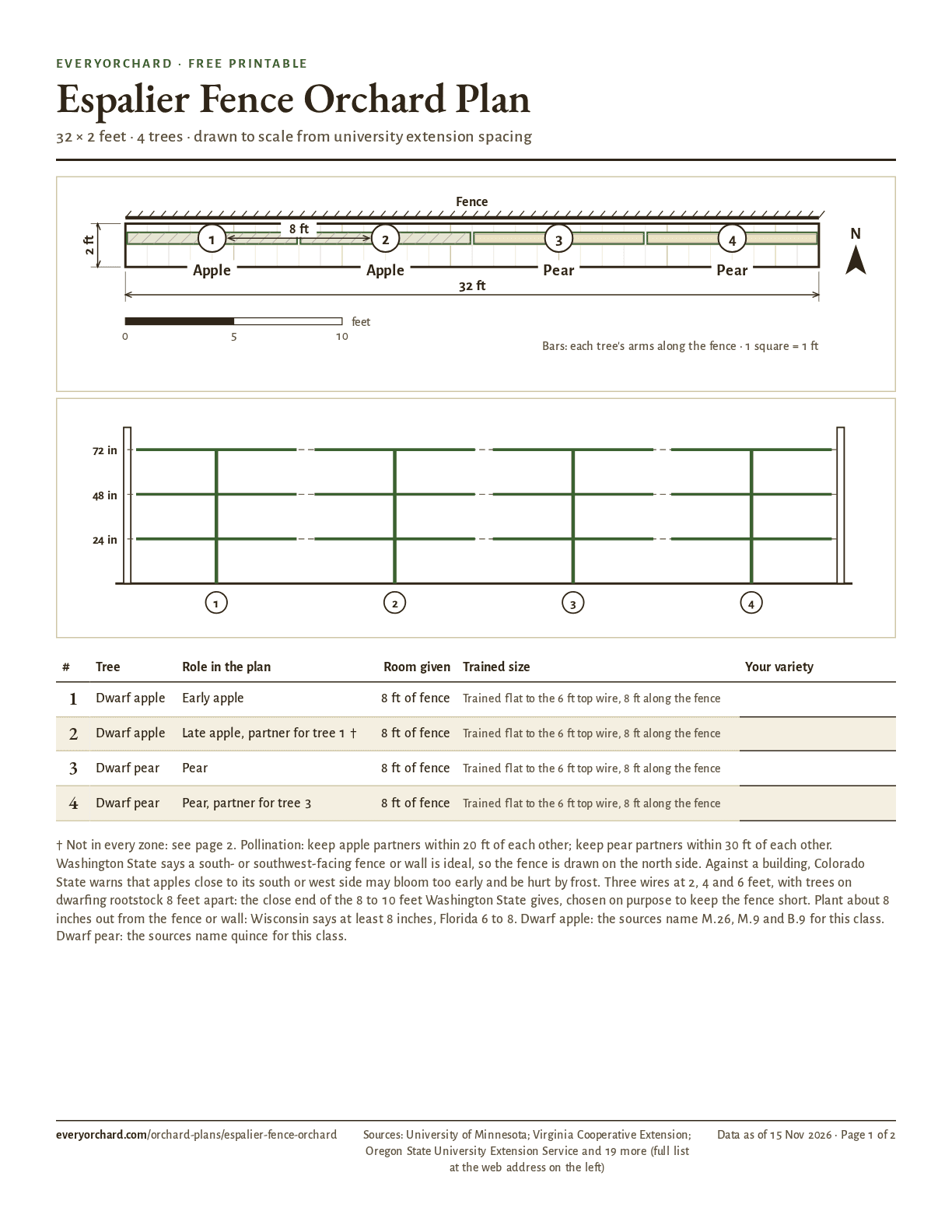
The plan, to scale
Each bar is a tree trained flat along the fence, as long as its share of the fence; each square is one foot. Washington State says a south- or southwest-facing fence or wall is ideal, so the fence is drawn on the north side.
Why this plan works
An espalier trains trees flat against a fence, so this plan fits four fruit trees into a strip about 2 feet deep. Dwarf apples and pears are the fruits that espalier easily; most other kinds do not. Washington State's horizontal espalier puts wires at 2, 4 and 6 feet on a south- or southwest-facing fence and spaces trees on dwarfing rootstock 8 to 10 feet apart. This plan uses 8 feet, the close end of that range on purpose, so four trees fit along 32 feet of fence.
Two apples and two pears make two pollination pairs, each tree 8 feet from its partner. With the zone 6 picks below, the harvest runs from July (Yellow Transparent) to October (Red Delicious).
Set the trees about 8 inches out from the fence so air can move behind them. Against a building, watch for early bloom: Colorado State warns that apples close to the south or west side of a building may bloom too early and be hurt by frost. The thing to get right is starting the support with the tree: Iowa State says to install a sturdy support system at planting.
What you need
- Space: 32 by 2 feet, about 64 square feet.
- Trees: 2 dwarf apples, 2 dwarf pears.
- Sun: At least 6 hours of direct sun a day; some sources ask for 8.
- Apple partners: keep them within 20 feet of each other. Each pair here stands closer than that.
- Pear partners: keep them within 30 feet of each other. Each pair here stands closer than that.
- Three wires at 2, 4 and 6 feet, with trees on dwarfing rootstock 8 feet apart: the close end of the 8 to 10 feet Washington State gives, chosen on purpose to keep the fence short.
- Plant about 8 inches out from the fence or wall: Wisconsin says at least 8 inches, Florida 6 to 8.
- Siting: Against a building, Colorado State warns that apples close to its south or west side may bloom too early and be hurt by frost.
- Support: Dwarf apples need a stake, post or trellis for the life of the tree.
- Support: Stake young pears at planting; Minnesota says the stake can come out after a few years.
Plant list
| # | Tree | Role | Room given | Trained size |
|---|---|---|---|---|
| 1 | Dwarf apple | Early apple | 8 ft of fence | Trained flat to the 6 ft top wire, 8 ft along the fence |
| 2 | Dwarf apple | Late apple, partner for tree 1 | 8 ft of fence | Trained flat to the 6 ft top wire, 8 ft along the fence |
| 3 | Dwarf pear | Pear | 8 ft of fence | Trained flat to the 6 ft top wire, 8 ft along the fence |
| 4 | Dwarf pear | Pear, partner for tree 3 | 8 ft of fence | Trained flat to the 6 ft top wire, 8 ft along the fence |
- Dwarf apple: the sources name M.26, M.9 and B.9 for this class.
- Dwarf pear: the sources name quince for this class.
Variety picks for your zone
Every pick is a good fit for the zone by the site’s fit check (chill hours and cold hardiness at a typical location in that zone), and every tree that needs a partner has one in the plan whose bloom overlaps. Where the site’s data has no variety for a spot, the panel says so. Check your own ZIP with the variety fit tool.
Picks for zone 4
- 1
Early apple
Good fit for zone 4; bloom group 2, pollinated by Honeycrisp (tree 2); early harvest, Jul–Aug.
- 2
Second apple, partner for tree 1
No late apple fits zone 4; this is the latest that does. Good fit for zone 4; bloom group 3, pollinated by Yellow Transparent (tree 1); harvest Sep–Oct.
- 3
- 4
Pear, partner for tree 3
Good fit for zone 4; bloom group 2, pollinated by Golden Spice (tree 3); harvest Aug.
Picks for zone 5
- 1
Early apple
Good fit for zone 5; bloom group 2, pollinated by Red Delicious (tree 2); early harvest, Jul–Aug.
- 2
Late apple, partner for tree 1
Good fit for zone 5; bloom group 3, pollinated by Yellow Transparent (tree 1); late harvest, Oct.
Or: Arkansas Black; GoldRush
- 3
- 4
Pear, partner for tree 3
Good fit for zone 5; bloom group 2, pollinated by Patten (tree 3); harvest Aug.
Or: Golden Spice; Parker
Picks for zone 6
- 1
Early apple
Good fit for zone 6; bloom group 2, pollinated by Red Delicious (tree 2); early harvest, Jul–Aug.
Or: Ginger Gold; Earligold
- 2
Late apple, partner for tree 1
Good fit for zone 6; bloom group 3, pollinated by Yellow Transparent (tree 1); late harvest, Oct.
Or: GoldRush; Arkansas Black
- 3
- 4
Pear, partner for tree 3
Good fit for zone 6; bloom group 2, pollinated by D'Anjou (tree 3); harvest Aug.
Or: Summercrisp; Golden Spice
Picks for zone 7
- 1
Early apple
Good fit for zone 7; bloom group 2, pollinated by McIntosh (tree 2); early harvest, Jul–Aug.
Or: Ginger Gold; Earligold
- 2
Late apple, partner for tree 1
Good fit for zone 7; bloom group 2, pollinated by Yellow Transparent (tree 1); late harvest, Oct.
Or: CandyCrisp; Fortune
- 3
- 4
Pear, partner for tree 3
Good fit for zone 7; bloom group 2, pollinated by D'Anjou (tree 3); harvest Aug.
Picks for zone 8
- 1
Early apple
Good fit for zone 8; bloom group 2, pollinated by McIntosh (tree 2); early harvest, Jul–Aug.
Or: Ginger Gold
- 2
Late apple, partner for tree 1
Good fit for zone 8; bloom group 2, pollinated by Yellow Transparent (tree 1); late harvest, Oct.
Or: Red Delicious; Braeburn
- 3
- 4
Pear, partner for tree 3
Good fit for zone 8; bloom group 3, pollinated by D'Anjou (tree 3); harvest Aug.
Picks for zone 9
- 1
Early apple
No apple variety in the site's data is a good fit in zone 9.
- 2
Late apple, partner for tree 1
No apple variety in the site's data is a good fit in zone 9.
- 3
- 4
Pear, partner for tree 3
Good fit for zone 9; bloom group 3, pollinated by Kieffer (tree 3); harvest Aug.
How to adapt the plan
- Keep each numbered partner next to the tree it pollinates; if you move one, keep the pair within the partner distance above.
- Some rootstocks, soils and training systems call for different spacing:
- Dwarf apples in strong soils or for vigorous varieties: 14 ft apart (Virginia).
- Dwarf apples on M.9: 4–8 ft apart (NC State).
- Changing tree size changes the room each tree needs. From the same sources:
- Apple: dwarf 12 ft, semi-dwarf 18 ft, standard 30 ft apart.
- Pear: dwarf 15 ft, standard 25 ft apart.
- To swap a variety, choose another good fit for your ZIP, and for apples and pears check it against its partner with the pollination checker.
Spacing figures and sources
Each tree's circle is as wide as the widest spacing university extension sources recommend for home gardens for its size class as a whole, and neighboring circles touch, so two trees stand half of each one's spacing apart. A bigger size class never gets less room than a smaller one of the same fruit. Figures for one rootstock, soil or training system are listed under How to adapt the plan.
Dwarf apple: 12 ft for each tree
| Source | Height | Spread | Spacing | What it says |
|---|---|---|---|---|
| University of Minnesota | 8–10 ft | — | 6–10 ftsets the plan | From the table in Growing apples in the home garden. |
| University of MinnesotaM.26 | 8–10 ft | — | — | “M.26 (also: EMLA 26 – virus-free): This dwarfing rootstock produces a tree 8-10 feet high (55-60% of standard tree).” |
| VirginiaM.26 | 10–14 ft | — | 14 ft | From the table in Growing Apples in Virginia (422-023). |
| VirginiaM.9 | 8–10 ft | — | 12 ft | From the table in Growing Apples in Virginia (422-023). |
| Virginia | — | — | 8 ftsets the plan | From the table in Tree Fruit in the Home Garden (426-841). |
| VirginiaM.9 | 7–8 ft | — | — | “the same variety of apple will produce a 16- to 18-foot tree on the rootstock Malling Merton (MM)111, down to a dwarf tree of 7 to 8 feet on a Malling (M)9 rootstock.” |
| Oregon State UniversityM-9, M-26, Bud 9 | 6–15 ft | 5–10 ft | — | From the table in Growing tree fruits and nuts at home (EC 819). |
| Colorado State University | 5–10 ft | 6 ft | — | From the table in Growing Tree Fruit in Colorado Gardens. |
| Iowa State University | 8–10 ft | — | 8–12 ftsets the plan | “Apple trees grafted to dwarf rootstocks will grow to approximately 8-10 feet tall, depending on cultivar, and often require support. … Apple trees on a dwarf rootstock can be spaced 8 to 12 feet apart” |
| NC StateM.26 | — | — | 8–12 ft | From the table in Extension Gardener Handbook, 15. Tree Fruit and Nuts. |
| NC StateM.9 | — | — | 4–8 ft | From the table in Extension Gardener Handbook, 15. Tree Fruit and Nuts. |
| UMass Amherst Center for AgricultureM.9 or B.9 | — | — | 4–5 ft | “Trees that are propagated on either M.9 or B.9 rootstock must be used and these are fully dwarfing rootstocks. … A support system is necessary since trees propagated on dwarfing rootstocks cannot stand without aid. … Using this system, trees can be planted as close as 4 to 5 feet apart.” |
| University of MissouriB.9 or M.9 | 10 ft | — | 6 ft | “The two dwarfing rootstocks recommended for vertical axis orchards in Missouri are B.9 and M.9 rootstocks. … a recommended spacing for a non-spur cultivar on B.9 or M.9 rootstock is 6 feet between trees within the rows and 14 feet between the rows, for a total of 518 trees per acre. … The height of mature trees in a vertical axis orchard system is usually about 10 feet.” |
Dwarf pear: 15 ft for each tree
| Source | Height | Spread | Spacing | What it says |
|---|---|---|---|---|
| University of New Hampshirequince | — | — | 8 ftsets the plan | “Traditionally, quince roots were used to create dwarf pear trees. The result is a tree approximately half the size of seedling-rootstock trees. … Dwarf pear trees are normally planted eight feet apart.” |
| Colorado State University | 12 ft | 12 ft | — | From the table in Growing Tree Fruit in Colorado Gardens. |
| Kansas State University | — | — | 15 ftsets the plan | From the table in Planning Your Fruit Garden (MF352). |
| Virginia | — | — | 12 ftsets the plan | From the table in Tree Fruit in the Home Garden (Relf and Marini, archived scan). |
Next steps
Sources
Every spacing figure on this page comes from these extension sources, and the variety picks from the site's variety data and its sources.
- [1] University of Minnesota Extension. Growing apples in the home garden — accessed November 2026
- [2] Virginia Cooperative Extension. Growing Apples in Virginia (422-023) — accessed November 2026
- [3] Virginia Cooperative Extension. Tree Fruit in the Home Garden (426-841) — accessed November 2026
- [4] Oregon State University Extension Service. Growing tree fruits and nuts at home (EC 819) — accessed November 2026
- [5] Colorado State University Extension. Growing Tree Fruit in Colorado Gardens — accessed November 2026
- [6] Iowa State University Extension and Outreach. Growing Apples in the Home Garden — accessed November 2026
- [7] NC State Extension. Extension Gardener Handbook, 15. Tree Fruit and Nuts — accessed November 2026
- [8] UMass Amherst Center for Agriculture, Food, and the Environment. Apples: A High Density Growing System for the Home Garden — accessed November 2026
- [9] University of Missouri Extension. The Vertical Axis System: A Training Method for Growing Apple Trees (G6024) — accessed November 2026
- [10] University of New Hampshire Extension. Growing Fruits: Growing Pears in the Home Orchard [fact sheet] — accessed November 2026
- [11] Colorado State University Extension. Growing Tree Fruit in Colorado Gardens — accessed November 2026
- [12] Kansas State University Research and Extension. Planning Your Fruit Garden (MF352) — accessed November 2026
- [13] Virginia Cooperative Extension (Virginia Tech). Tree Fruit in the Home Garden (Relf and Marini, archived scan) — accessed November 2026
- [14] University of Saskatchewan, Gardening at USask. Apples — accessed November 2026
- [15] The Ohio State University Extension (Bulletin 940), hosted by Purdue Extension Vigo County. Midwest Home Fruit Production Guide (Bulletin 940) — accessed November 2026
- [16] Virginia Cooperative Extension. Growing Apples in Virginia (422-023) — accessed November 2026
- [17] University of Maryland Extension. Starting a Home Fruit Garden — accessed November 2026
- [18] Virginia Cooperative Extension. Growing Pears in Virginia (422-017) — accessed November 2026
- [19] Virginia Cooperative Extension (Virginia Tech). Growing Pears in Virginia (422-017) — accessed November 2026
- [20] University of Kentucky Cooperative Extension. Growing Tree Fruits (HO-104) — accessed November 2026
- [21] University of Arkansas Cooperative Extension Service. Pear Production in the Home Garden (FSA6059) — accessed November 2026
- [22] University of Idaho College of Agriculture (Current Information Series, 1991 scan). Pears in the Home Garden (Current Information Series) — accessed November 2026
- [23] Washington State University Extension, Clallam County Master Gardeners. Two-Dimensional Fruit Trees for the Small Yard — accessed November 2026
- [24] University of Florida IFAS Extension (EDIS archival copy). Espaliers (CIR627) — accessed November 2026
- [25] Colorado State University Extension (PlantTalk Colorado). 1201 - Apples — accessed November 2026
- [26] University of Wisconsin-Madison Extension. Espalier — accessed November 2026
- [27] Oregon State University Extension Service. Growing tree fruits and nuts at home (EC 819) — accessed November 2026
- [28] Dave Wilson Nursery. Apples — DWN Variety Finder product list — accessed July 2026
- [29] Utah State University Extension. Apple Production and Variety Recommendations for the Utah Home Garden — accessed July 2026
- [30] Dave Wilson Nursery. Asian pears — DWN Variety Finder product list — accessed July 2026
- [31] Dave Wilson Nursery. European pears — DWN Variety Finder product list — accessed July 2026
- [32] Washington State University Tree Fruit. Pollination — Pear (WSU Tree Fruit) — accessed July 2026
- [33] University of Minnesota Extension. Growing apples in the home garden — accessed July 2026
- [34] University of Minnesota Extension. Growing pears in the home garden — accessed July 2026
- [35] University of Minnesota. Honeycrisp — Minnesota Hardy (U of M fruit breeding program) — accessed July 2026