Sweet Cherry variety
Royal Ann
Also known as Napoleon, Royal Anne
Growing facts
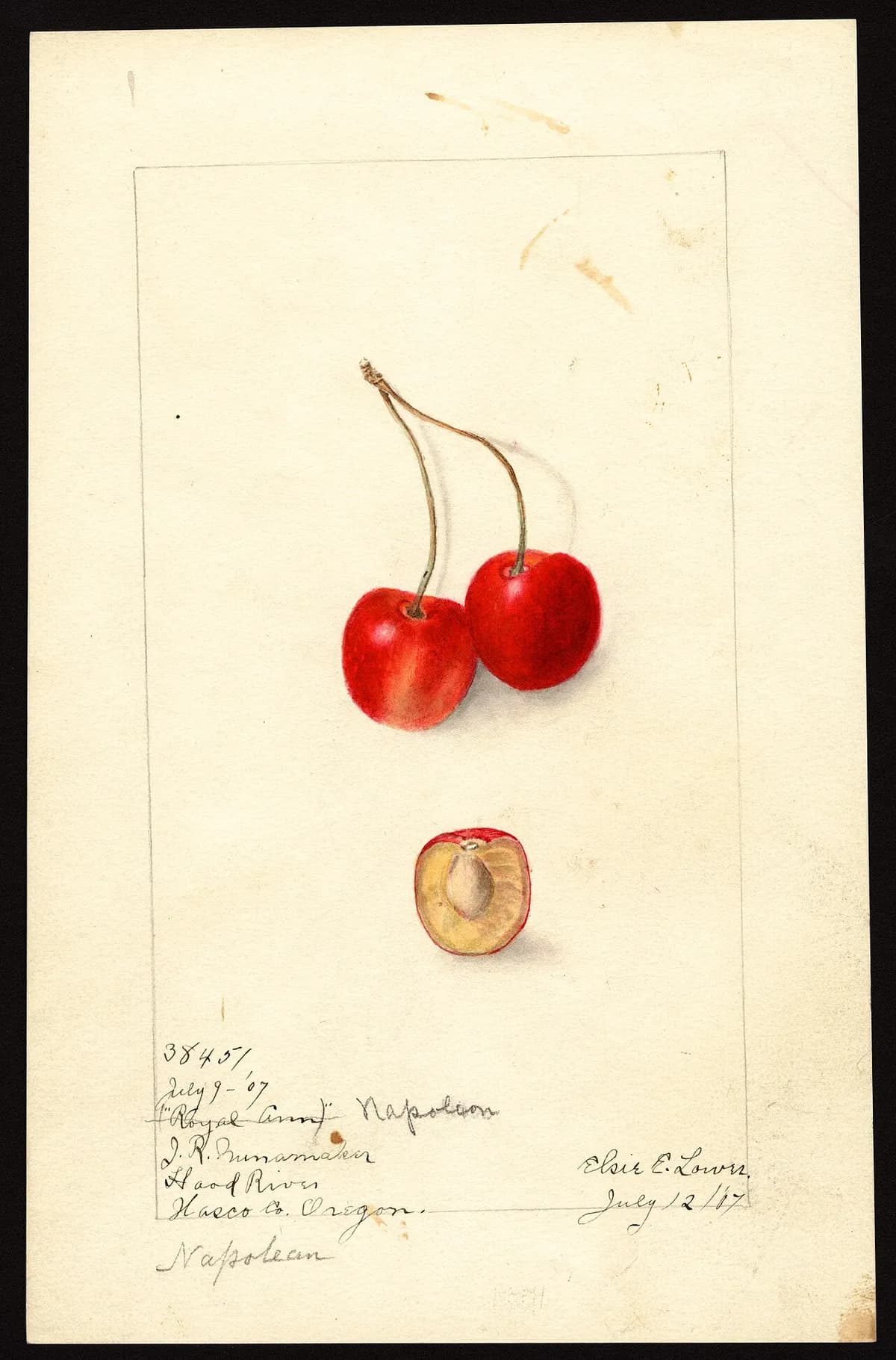
Plate provenance[4]
Pollination partners
Royal Ann blooms in group 3. The closest bloom-time matches make the most reliable partners:
Show 2 more compatible varieties
Notes
A year with your Royal Ann
When the work happens for a sweet cherry in USDA zone 6, anchored to typical frost dates.
| Task | J | F | M | A | M | J | J | A | S | O | N | D |
|---|---|---|---|---|---|---|---|---|---|---|---|---|
| Prune | — | — | — | — | — | — | — | — | — | — | ||
| Spray timing | — | — | — | — | — | |||||||
| Harvest | — | — | — | — | — | — | — | — | — | |||
| Care | — | — | — | — | — | — | — | — | — | — | — |
See the full month-by-month sweet cherry calendar for zone 6 →
Can I grow Royal Ann where I live?
Check the verdict for a few regions, or your exact ZIP:
Growing a Royal Ann? Get its care calendar for your exact ZIP code, with email reminders.
Save this tree in My OrchardQuestions
- How many chill hours does Royal Ann need?
- Royal Ann needs 700 chill hours.
- What hardiness zones suit Royal Ann?
- Royal Ann grows in USDA zones 5–7.
- Is Royal Ann self-pollinating?
- No — Royal Ann needs a compatible pollination partner nearby.
Sources
- [1] Dave Wilson Nursery. Cherries — DWN Variety Finder product list — accessed July 2026
- [2] Utah State University Extension (Intermountain Tree Fruit Production Guide). Varieties for Utah — Cherry — accessed July 2026
- [3] University of Maine Cooperative Extension. Growing Fruit Trees in Maine — Lack of Fruitfulness — accessed July 2026
- [4] USDA National Agricultural Library. USDA Pomological Watercolor Collection (Rare and Special Collections, 1886-1942) — accessed July 2026
- [5] Washington State University Tree Fruit. Pollination – Sweet Cherry (WSU Tree Fruit) — accessed July 2026
- [6] Washington State University Tree Fruit. Bacterial canker in Washington sweet cherries (WSU Tree Fruit) — accessed July 2026