Peach variety
Elberta
Growing facts
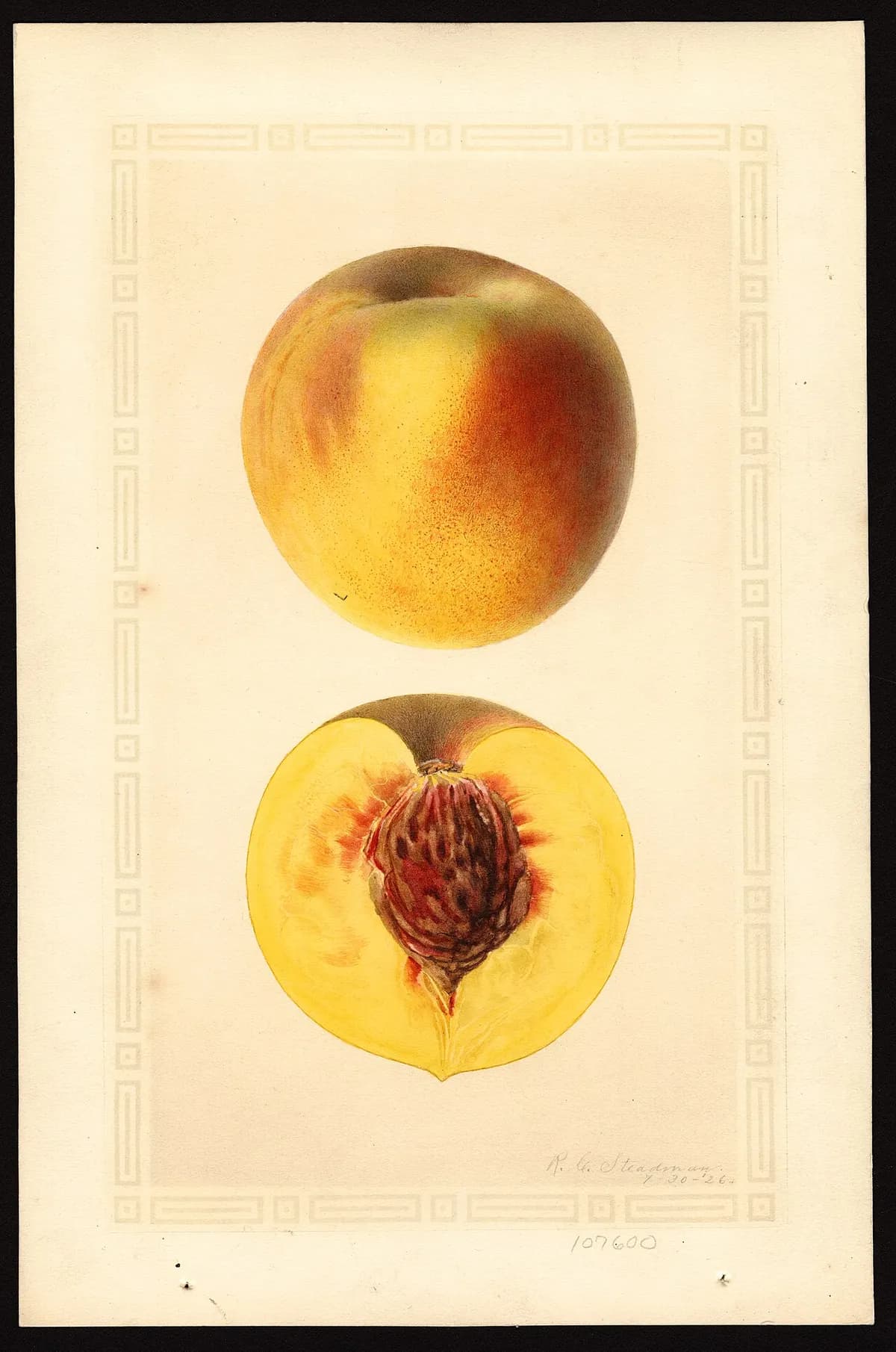
Plate provenance[4]
Notes
- Classic yellow, melting-flesh freestone; ripens mid-July in the Southeast and late July/early August in Central California.[1]
- Susceptible to bacterial spot.[5]
- Peach leaf curl (Taphrina deformans) affects peaches and nectarines; most cultivars lack resistance and a dormant fungicide spray provides control.[6]
- Brown rot is the most damaging stone-fruit disease and can destroy a ripening crop on unsprayed trees.[1]
- Self-fruitful.[2]
A year with your Elberta
When the work happens for a peach in USDA zone 6, anchored to typical frost dates.
| Task | J | F | M | A | M | J | J | A | S | O | N | D |
|---|---|---|---|---|---|---|---|---|---|---|---|---|
| Prune | — | — | — | — | — | — | — | — | — | — | ||
| Thin | — | — | — | — | — | — | — | — | — | — | — | |
| Spray timing | — | — | — | — | — | — | ||||||
| Harvest | — | — | — | — | — | — | — | — | ||||
| Care | — | — | — | — | — | — | — | — | — | — | — |
Can I grow Elberta where I live?
Check the verdict for a few regions, or your exact ZIP:
Growing an Elberta? Get its care calendar for your exact ZIP code, with email reminders.
Save this tree in My OrchardQuestions
- How many chill hours does Elberta need?
- Elberta needs 750–900 chill hours.
- Is Elberta self-pollinating?
- Elberta is self-fertile, though a pollination partner can improve cropping.
Sources
- [1] University of Georgia Extension (CAES). Home Garden Peaches (Circular 1063) — accessed July 2026
- [2] Dave Wilson Nursery. Peaches — DWN Variety Finder product list — accessed July 2026
- [3] University of Maine Cooperative Extension. Growing Fruit Trees in Maine — Lack of Fruitfulness — accessed July 2026
- [4] USDA National Agricultural Library. USDA Pomological Watercolor Collection (Rare and Special Collections, 1886-1942) — accessed July 2026
- [5] Michigan State University Extension. Management of bacterial spot on peaches and nectarines — accessed July 2026
- [6] University of Maine Cooperative Extension. Peach Leaf Curl (Bulletin 5098e) — accessed July 2026