Free printable · Care calendars and checklists
May Orchard Checklist
The fruit tree jobs for May on one page, with check boxes, sorted into three climate bands from cold zone 3 to warm zone 10.
For May, find your climate band, from cold zones 3–5 to warm zones 8–10, and work down its list. Every job comes from a university extension source; the months are typical for each band, so let your own frost dates and trees have the final say.
Download the PDF(PDF, 51 KB)US Letter, 1 page. Free, no sign-up.
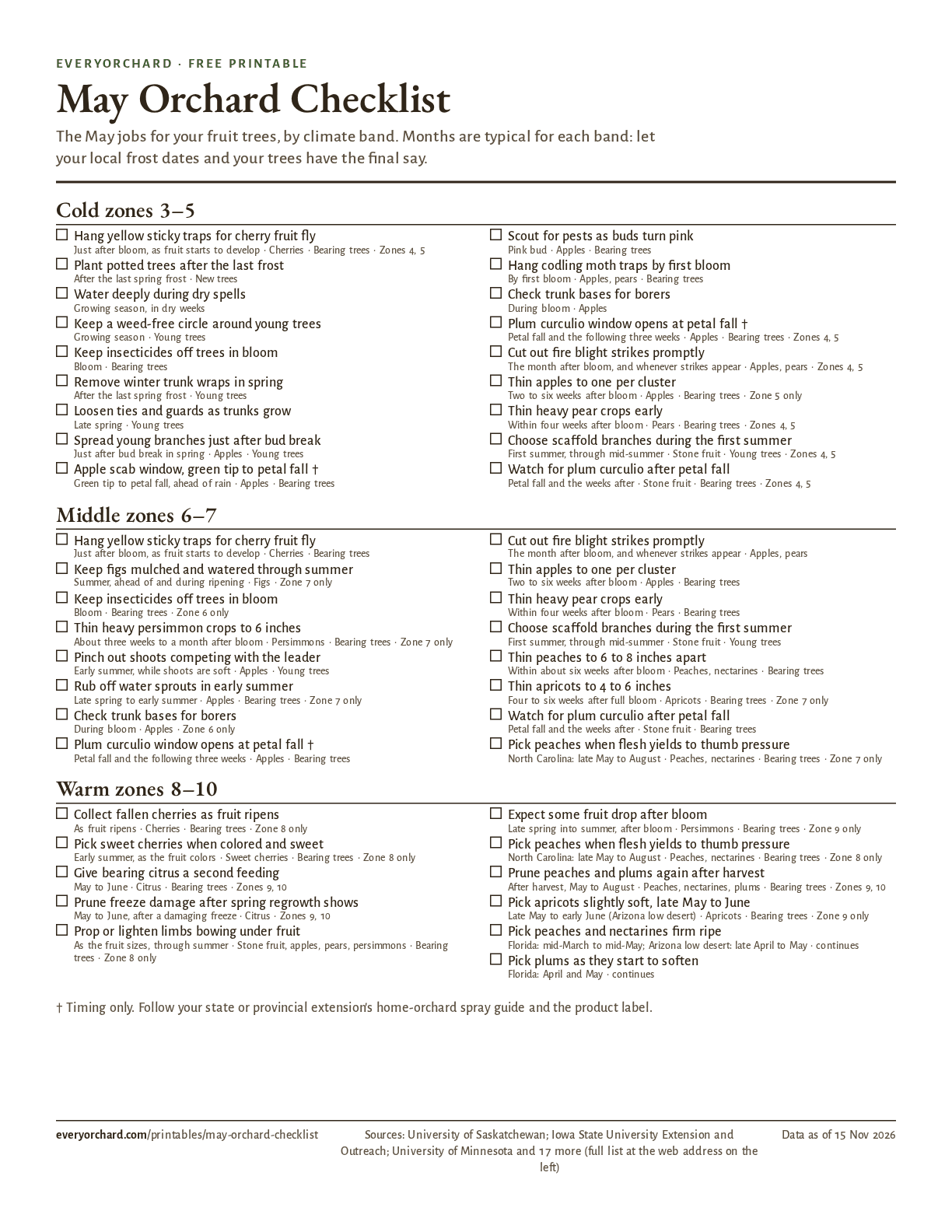
What’s on the sheet
Cold zones 3–5
- Hang yellow sticky traps for cherry fruit fly (Cherries · Bearing trees · Zones 4, 5)
- Plant potted trees after the last frost (New trees)
- Water deeply during dry spells
- Keep a weed-free circle around young trees (Young trees)
- Keep insecticides off trees in bloom (Bearing trees)
- Remove winter trunk wraps in spring (Young trees)
- Loosen ties and guards as trunks grow (Young trees)
- Spread young branches just after bud break (Apples · Young trees)
- Apple scab window, green tip to petal fall † (Apples · Bearing trees)
- Scout for pests as buds turn pink (Apples · Bearing trees)
- Hang codling moth traps by first bloom (Apples, pears · Bearing trees)
- Check trunk bases for borers (Apples)
- Plum curculio window opens at petal fall † (Apples · Bearing trees · Zones 4, 5)
- Cut out fire blight strikes promptly (Apples, pears · Zones 4, 5)
- Thin apples to one per cluster (Apples · Bearing trees · Zone 5 only)
- Thin heavy pear crops early (Pears · Bearing trees · Zones 4, 5)
- Choose scaffold branches during the first summer (Stone fruit · Young trees · Zones 4, 5)
- Watch for plum curculio after petal fall (Stone fruit · Bearing trees · Zones 4, 5)
Middle zones 6–7
- Hang yellow sticky traps for cherry fruit fly (Cherries · Bearing trees)
- Keep figs mulched and watered through summer (Figs · Zone 7 only)
- Keep insecticides off trees in bloom (Bearing trees · Zone 6 only)
- Thin heavy persimmon crops to 6 inches (Persimmons · Bearing trees · Zone 7 only)
- Pinch out shoots competing with the leader (Apples · Young trees)
- Rub off water sprouts in early summer (Apples · Bearing trees · Zone 7 only)
- Check trunk bases for borers (Apples · Zone 6 only)
- Plum curculio window opens at petal fall † (Apples · Bearing trees)
- Cut out fire blight strikes promptly (Apples, pears)
- Thin apples to one per cluster (Apples · Bearing trees)
- Thin heavy pear crops early (Pears · Bearing trees)
- Choose scaffold branches during the first summer (Stone fruit · Young trees)
- Thin peaches to 6 to 8 inches apart (Peaches, nectarines · Bearing trees)
- Thin apricots to 4 to 6 inches (Apricots · Bearing trees · Zone 7 only)
- Watch for plum curculio after petal fall (Stone fruit · Bearing trees)
- Pick peaches when flesh yields to thumb pressure (Peaches, nectarines · Bearing trees · Zone 7 only · North Carolina)
Warm zones 8–10
- Collect fallen cherries as fruit ripens (Cherries · Bearing trees · Zone 8 only)
- Pick sweet cherries when colored and sweet (Sweet cherries · Bearing trees · Zone 8 only)
- Give bearing citrus a second feeding (Citrus · Bearing trees · Zones 9, 10)
- Prune freeze damage after spring regrowth shows (Citrus · Zones 9, 10)
- Prop or lighten limbs bowing under fruit (Stone fruit, apples, pears, persimmons · Bearing trees · Zone 8 only)
- Expect some fruit drop after bloom (Persimmons · Bearing trees · Zone 9 only)
- Pick peaches when flesh yields to thumb pressure (Peaches, nectarines · Bearing trees · Zone 8 only · North Carolina)
- Prune peaches and plums again after harvest (Peaches, nectarines, plums · Bearing trees · Zones 9, 10)
- Pick apricots slightly soft, late May to June (Apricots · Bearing trees · Zone 9 only)
- Pick peaches and nectarines firm ripe (continues · Peaches, nectarines · Bearing trees · Zones 9, 10 · Florida and Arizona)
- Pick plums as they start to soften (continues · Plums · Bearing trees · Zone 9 only · Florida)
† Follow your state or provincial extension's home-orchard spray guide and the product label.
Jobs as of November 15, 2026, from the same care library the site’s calendars use.
Use it with
Sources
Every figure on this printable comes from these sources.
- [1] University of Saskatchewan (Gardening at USask). Cherry maggot fly — accessed November 2026
- [2] Iowa State University Extension and Outreach. Growing cherries in the home garden — accessed November 2026
- [3] University of Minnesota Extension. Growing apples in the home garden — accessed November 2026
- [4] Virginia Cooperative Extension. Growing pears in Virginia (422-017) — accessed November 2026
- [5] Virginia Cooperative Extension. Growing apples in Virginia (422-023) — accessed November 2026
- [6] NC State Extension. Extension Gardener Handbook, chapter 15: Tree fruit and nuts — accessed November 2026
- [7] Oregon State University Extension Service. Growing tree fruits and nuts in the home orchard (EC 819) — accessed November 2026
- [8] Penn State Extension. Applying mulches in home fruit plantings — accessed November 2026
- [9] Clemson Cooperative Extension Home & Garden Information Center. Planting trees correctly — accessed November 2026
- [10] University of Saskatchewan (Gardening at USask). Apples — accessed November 2026
- [11] University of Missouri Extension. Home fruit spray schedule (G6010) — accessed November 2026
- [12] Utah State University Extension. Sunscald injury or southwest winter injury on deciduous trees — accessed November 2026
- [13] University of Tennessee Extension. Protecting fruit trees from winter injury (SP307-G) — accessed November 2026
- [14] Utah State University Extension. Training and pruning apple trees — accessed November 2026
- [15] University of Maine Cooperative Extension. Home apple pest management calendar — accessed November 2026
- [16] University of Illinois Extension. Dormant pruning and sprays for apple fruit trees — accessed November 2026
- [17] Utah State University Extension. Codling moth (ENT-13-06) — accessed November 2026
- [18] Utah State University Extension. Fire blight — accessed November 2026
- [19] Iowa State University Extension and Outreach. Alternate bearing, fruit drop, and hand thinning of tree fruits — accessed November 2026
- [20] University of Minnesota Extension. Growing stone fruits in the home garden — accessed November 2026
- [21] Clemson Cooperative Extension Home & Garden Information Center. Pruning peaches and nectarines — accessed November 2026
- [22] University of Georgia Cooperative Extension. Home garden peaches (C1063) — accessed November 2026
- [23] Texas A&M AgriLife Extension Service. Texas Fruit and Nut Production: Figs (EHT-019) — accessed November 2026
- [24] University of Georgia Cooperative Extension. Home Garden Figs (Circular 945) — accessed November 2026
- [25] University of Georgia Cooperative Extension. Home Garden Persimmons (Circular 784) — accessed November 2026
- [26] UF/IFAS Extension. Japanese Persimmon Cultural Practices in Florida (HS1389) — accessed November 2026
- [27] Iowa State University Extension and Outreach. Pruning apple trees — accessed November 2026
- [28] Penn State Extension. Peach tree pruning: managing light and crop load — accessed November 2026
- [29] University of Maine Cooperative Extension. Growing peaches in Maine (Bulletin 2068) — accessed November 2026
- [30] University of New Hampshire Cooperative Extension. Growing peaches and nectarines in the home garden — accessed November 2026
- [31] Utah State University Extension. How to grow apricots in your home garden — accessed November 2026
- [32] UC Statewide IPM Program. Thinning apricots — accessed November 2026
- [33] NC State Extension. Peach cultivars — accessed November 2026
- [34] UC Statewide IPM Program. Harvesting and storing cherries — accessed November 2026
- [35] Texas A&M AgriLife Extension (Aggie Horticulture). Home Fruit Production - Citrus — accessed November 2026
- [36] UC Statewide IPM Program (UC ANR). Cultural tips for growing citrus — accessed November 2026
- [37] LSU AgCenter (East Baton Rouge Parish). Citrus tree care — accessed November 2026
- [38] University of Arizona Cooperative Extension. Citrus Fertilization Chart for Arizona — accessed November 2026
- [39] UF/IFAS Citrus Research and Education Center. Home citrus - Fertilizing — accessed November 2026
- [40] LSU AgCenter. Pruning and Fertilizing Fruit and Nut Trees — accessed November 2026
- [41] UC Statewide IPM Program (UC ANR). Freezing and frost damage to citrus — accessed November 2026
- [42] University of Arizona Cooperative Extension. Protecting a Citrus Tree from Cold (AZ1222) — accessed November 2026
- [43] Oregon State University Extension Service. Fruit thinning — accessed November 2026
- [44] LSU AgCenter. Persimmon: the other orange fall fruit — accessed November 2026
- [45] Texas A&M AgriLife Extension Service. Texas Fruit and Nut Production: Persimmons (E-611) — accessed November 2026
- [46] UF/IFAS Extension (University of Florida). Training and Pruning Florida Peaches, Nectarines, and Plums (HS1111) — accessed November 2026
- [47] UF/IFAS Extension Gardening Solutions (University of Florida). Peaches — accessed November 2026
- [48] Texas A&M AgriLife Extension. Pruning Peach Trees — accessed November 2026
- [49] University of Arizona Cooperative Extension. Deciduous fruit and nuts for the low desert (AZ1269) — accessed November 2026
- [50] UF/IFAS Extension. Subtropical peach defoliation and chill hours (HS1492) — accessed November 2026
- [51] UC Statewide IPM Program (UC ANR). Cultural tips for growing peach and nectarine — accessed November 2026
- [52] UC Statewide IPM Program. Cultural tips for growing plum and prune — accessed November 2026